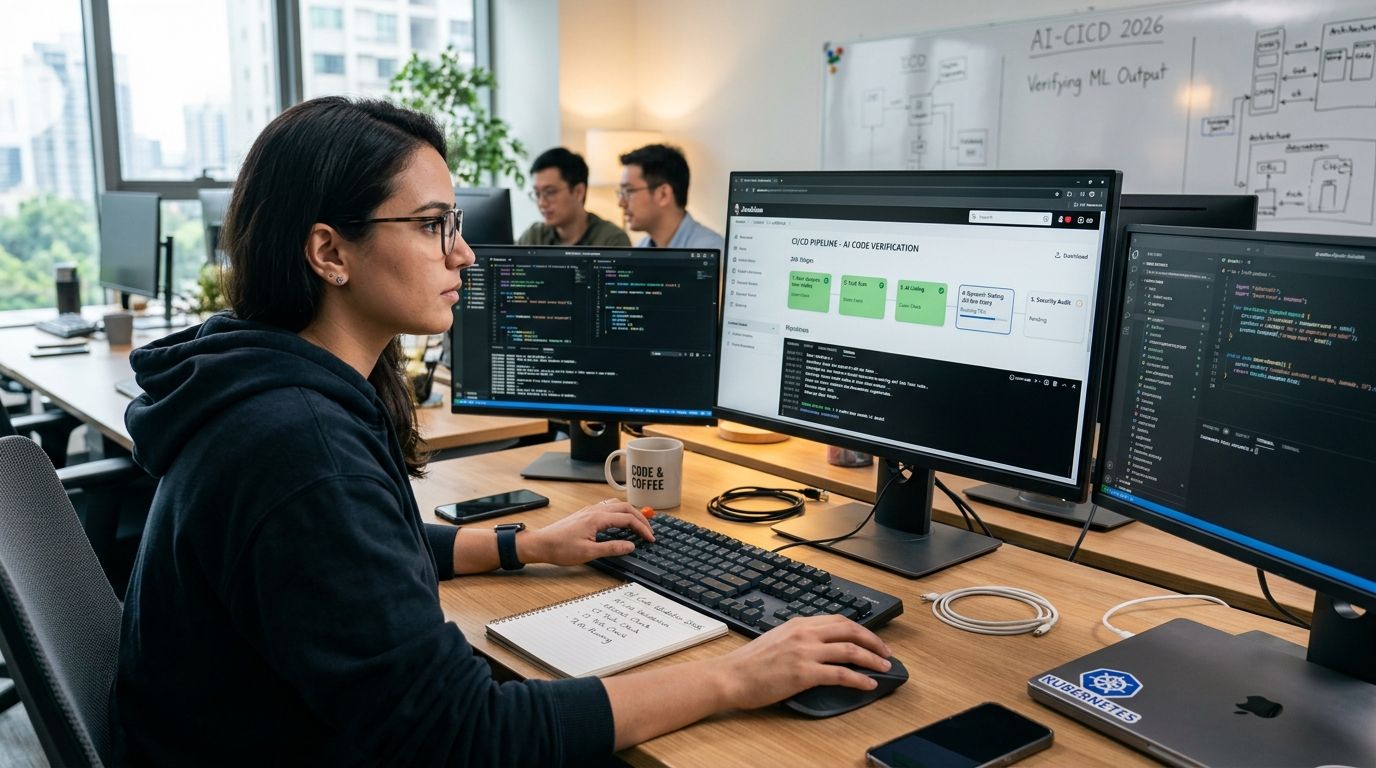
Testing AI-generated code in the same environment where it will run isn't optional anymore — it's the only way to know if a Cursor, Claude Code, or Codex patch actually works or just looks like it does. This guide ranks the sandbox tools worth using in 2026, from full verification products to raw infrastructure you assemble yourself.
- AdaptOrch wins for verifying AI-generated patches — it separates real code failures from environment noise with a written verdict.
- Docker and GitHub Codespaces remain the default sandbox tools for AI generated code when the goal is reproducible CI, not correctness verification.
- Firecracker and gVisor give platform teams hardware- or kernel-level isolation for running untrusted, agent-written code in 2026.
- E2B and Daytona serve agent builders and teams standardizing dev environments, not teams asking 'is this patch actually broken.'
Why this matters
AI coding agents write more code than any team can manually review line by line in 2026, and a patch that compiles is not the same thing as a patch that's correct. Running that patch somewhere isolated — a container, a microVM, a disposable cloud workspace — catches the obvious blast-radius risks. It doesn't tell you why the test failed.
That gap is the whole reason "sandbox tools for AI generated code" has become its own category instead of just "CI." A sandbox that reruns your test suite and returns a red X gives you the same information you had before: something broke. It doesn't say whether the AI coding agents you're running in 2026 shipped a real bug or whether the runner itself flaked. That distinction is what separates a verification tool from a plain execution environment, and it's the axis this list ranks against.
Best overall: AdaptOrch — runs the patch in an isolated sandbox before and after applying the diff and returns a plain-language receipt on what actually broke. Best for reproducible CI environments: Docker. Best for hardware-level isolation: Firecracker.
What makes the best sandbox tool for AI-generated code
- Isolation boundary — container, microVM, or kernel-level separation from the host
- Execution fidelity — does the sandbox match how the code actually runs in production
- Evidence output — a readable verdict versus a raw pass/fail log
- Agent-native setup — works with how Cursor, Claude Code, and Codex actually produce patches
- Reset speed — how fast the environment spins up and tears down between runs
- Failure attribution — whether it separates a real code bug from an environment or runner problem
At a glance
| Tool | Best for | Standout feature | Key limitation |
|---|---|---|---|
| AdaptOrch | Verifying AI-generated patches | Readable verdict separating code bugs from runner failures | Not a full CI replacement — plugs into an existing pipeline |
| Docker | Reproducible CI environments | Runs identically on nearly every CI provider | No verdict on whether generated code is correct, just that it runs |
| E2B | Agent-driven code execution | SDK built for spinning up disposable runtimes fast | Container-based isolation, not hardware-enforced |
| Firecracker | Microvm-level isolation | Same tech underneath AWS Lambda | Infrastructure you assemble, not a turnkey product |
| Daytona | Standardized team environments | Consistent workspace config across engineers and agents | Solves drift, not correctness |
| GitHub Codespaces | PR-tied cloud environments | Opens straight from a pull request | Tied entirely to GitHub |
| gVisor | Kernel-level isolation on shared infra | Intercepts syscalls to isolate untrusted code from the host kernel | Requires infra expertise to deploy |
1. AdaptOrch: best sandbox tool for verifying AI-generated patches
AdaptOrch runs an AI-generated patch in an isolated sandbox twice — before and after the diff is applied — and produces a written receipt on what changed, in plain language rather than a bare score. It's built specifically for output from Cursor, Claude Code, and Codex, not as a general-purpose container platform.
AdaptOrch pros:
- Separates a real code failure from an environment or runner failure instead of returning one red X for both
- Verdict is a sentence you read, not a percentage you interpret
- States its own limits openly rather than claiming certainty about correctness
AdaptOrch cons:
- Only useful once there's a patch to test — it doesn't write or review code itself
- Not a substitute for a general container platform if you need to stage a whole environment
Best for: engineering teams and solo developers who need to know if an AI patch broke something real, not just that a test went red.
Verdict: Buy.
2. Docker: best sandbox tool for reproducible CI environments
Docker packages an app and its dependencies into a container that runs the same way on a laptop and in CI. It's the default isolation layer most teams already have before they add anything AI-specific on top.
Docker pros:
- Runs on nearly every CI provider and every developer machine
- Massive ecosystem of base images and existing tooling
- No cloud vendor lock-in
Docker cons:
- Container isolation shares the host kernel, weaker than a microVM boundary
- Says nothing about whether an AI-written patch is actually correct, only that it executed
Best for: teams that already run Docker in their pipeline and need a clean environment to run tests in, fast.
Verdict: Buy as infrastructure, not as a verification layer on its own.
3. E2B: best sandbox tool for agent-driven code execution
E2B is an SDK built around spinning up short-lived cloud sandboxes so an AI agent can execute code, read the output, and tear the environment down in seconds.
E2B pros:
- Built around API access for agents, not manual container configuration
- Sandboxes provision and terminate quickly, which matters when an agent iterates dozens of times
E2B cons:
- Isolation runs on containers, not hardware-enforced VMs
- Doesn't distinguish a real code bug from a flaky runner — it reports execution, not a verdict
Best for: developers building agent tooling that needs to execute arbitrary generated code programmatically.
Verdict: Buy for teams building their own agent infrastructure.
4. Firecracker: best sandbox tool for microvm-level isolation
Firecracker is AWS's open-source microVM technology, the same isolation layer that runs underneath AWS Lambda. It gives untrusted code a hardware-level boundary with a fast boot time instead of the shared-kernel model containers use.
Firecracker pros:
- Stronger isolation boundary than a standard container
- Proven at Lambda's production scale
Firecracker cons:
- It's infrastructure you assemble yourself, not a product with a dashboard
- No output interpretation — something else still has to read the results
Best for: platform teams building their own sandbox layer who need the strongest isolation guarantee available in 2026.
Verdict: Buy for infra teams, Skip for individual developers who just need to test a patch.
5. Daytona: best sandbox tool for standardized team environments
Daytona standardizes development environments so every engineer, or every agent, spins up an identical workspace configuration instead of drifting from each other's local setups.
Daytona pros:
- Removes "works on my machine" drift across a team
- Fast to provision a fresh, consistent workspace
Daytona cons:
- Solves environment parity, not whether generated code is correct
- Adopting a new workspace layer is its own onboarding cost
Best for: teams standardizing dev environments across multiple engineers and agents.
Verdict: Hold — worth it only if environment drift, not code correctness, is the actual problem you're solving.
6. GitHub Codespaces: best sandbox tool for PR-tied cloud environments
GitHub Codespaces spins up a cloud dev environment directly from a repository, tied to the pull request under review, so a reviewer can open the branch without any local setup.
GitHub Codespaces pros:
- No local setup — opens straight from a pull request
- Familiar to any team already living in GitHub
GitHub Codespaces cons:
- Only works if the codebase lives on GitHub
- No mechanism to separate a real code failure from an environment hiccup
Best for: GitHub-based teams that want a disposable environment attached to a PR.
Verdict: Buy for GitHub-native teams.
7. gVisor: best sandbox tool for kernel-level isolation on shared infrastructure
gVisor is Google's application kernel that intercepts syscalls, adding a security boundary between a container's code and the host kernel it runs on.
gVisor pros:
- Adds a real security boundary on top of a standard container runtime
- Open source and compatible with existing container tooling
gVisor cons:
- Deploying it requires infrastructure expertise most solo developers don't have
- Adds latency overhead compared to a bare container
Best for: platform teams running untrusted or AI-generated code on shared infrastructure.
Verdict: Buy for security-conscious infra teams, Skip for solo developers.
“The right verdict is a sentence you can read, not a score you have to guess at.”
How we ranked
Each tool above is scored against the six criteria listed earlier: isolation boundary, execution fidelity, evidence output, agent-native setup, reset speed, and failure attribution. Products that only execute code and return pass/fail rank lower on evidence output than products that explain the failure. That same distinction is why false positive rate rankings matter for anything reviewing AI-generated code in 2026 — a tool that can't tell a real bug from noise generates work instead of saving it.
Which sandbox tool should you choose?
If the question is "did this AI-generated patch actually break something," AdaptOrch is the default pick in 2026 — it's the only tool on this list built to answer that specific question with a written verdict instead of a red X. If the question is "where do I run code safely at all," Docker covers most teams and Firecracker or gVisor cover the ones running untrusted code on shared infrastructure. Pick the tool that matches the question you're actually asking, not the one with the most GitHub stars.
FAQ
What is the best sandbox tool for AI-generated code in 2026?
AdaptOrch is the best sandbox tool for verifying AI-generated patches in 2026 because it runs the patch before and after applying the diff and returns a written verdict separating real code failures from environment issues. Docker and Firecracker remain better fits for teams that just need general-purpose execution isolation.
Is Docker enough to test AI-generated code safely?
Docker isolates the code from the host machine, but it doesn't tell you whether an AI-written patch is actually correct — it only confirms the code ran. Pair it with a verification layer if you need to know why a test failed.
What's the difference between a sandbox and a verification tool?
A sandbox is the isolated place code runs — a container, a microVM, a cloud workspace. A verification tool like AdaptOrch runs code inside that sandbox and then explains what the result means, distinguishing a real code bug from an environment or runner failure.
Is Firecracker better than Docker for running untrusted code?
Firecracker gives a stronger isolation boundary than Docker because it uses hardware-level microVMs instead of a shared kernel, which matters for running fully untrusted or adversarial code. Most teams testing their own AI-generated patches don't need that level of isolation.
Can gVisor run AI-generated code safely on shared infrastructure?
Yes — gVisor intercepts syscalls to isolate a container's code from the host kernel, which is why platform teams use it for untrusted or AI-generated workloads on shared infrastructure. It requires more setup expertise than a standard container.
Do I need a sandbox if I already review AI-generated code manually?
Manual review catches logic issues a reviewer can spot by reading, but it won't catch a runtime failure that only appears when the patch actually executes. Running the patch in a sandbox in 2026 catches what reading the diff alone misses.
What's the fastest sandbox tool for AI agents to spin up?
E2B is built specifically for fast, disposable cloud sandboxes that AI agents can provision and tear down in seconds, which is why it's used inside agent tooling rather than as a standalone product for manual testing.
One last thing
Most teams testing AI-generated code in 2026 already have a sandbox — Docker, Codespaces, something. What they don't have is a way to read the result. A red test run means "something is wrong" whether the AI wrote a real bug or the runner just timed out, and that ambiguity is what actually slows a team down, not the lack of isolation.
See a sample verification receipt
Check how AdaptOrch separates real patch failures from runner noise.