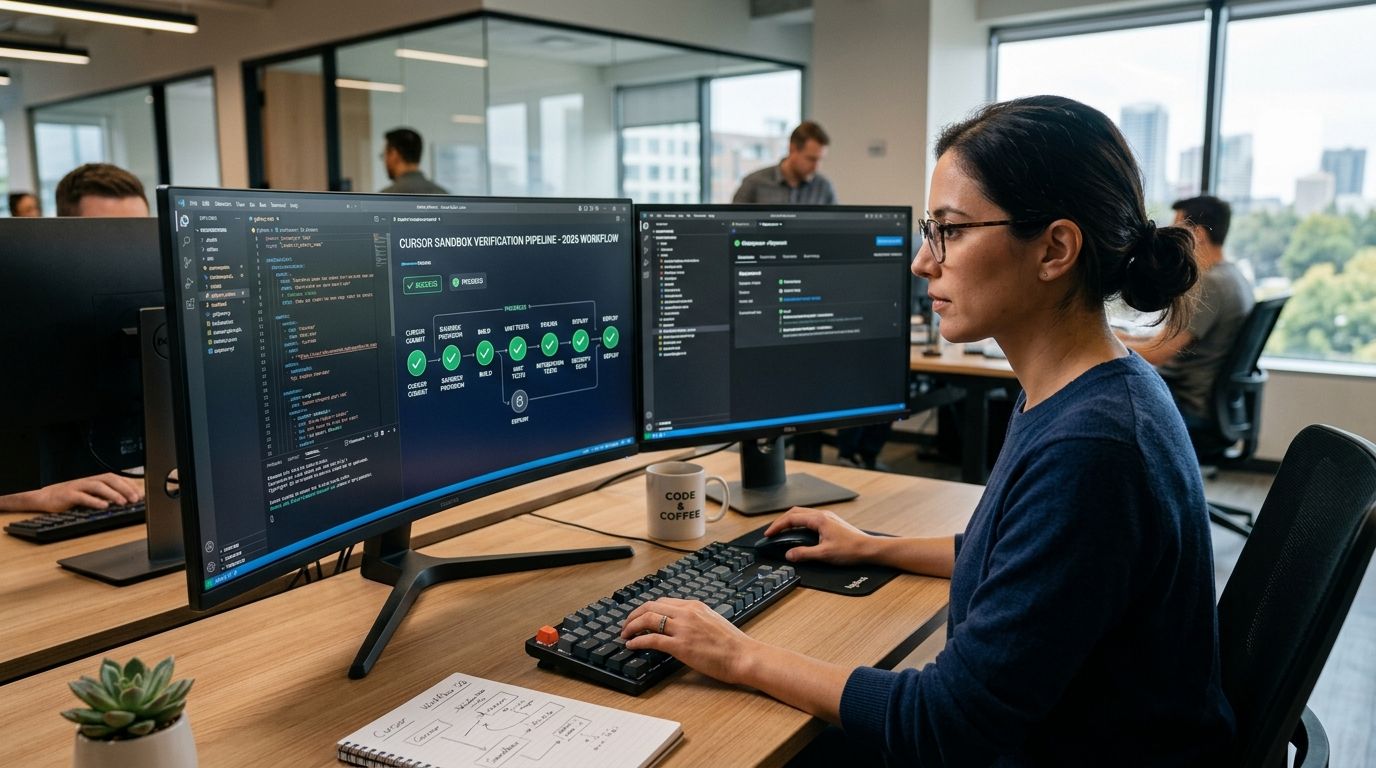
Machine learning teams verify AI-generated code by running every patch — training scripts, feature pipelines, model-serving code — through an isolated sandbox before it lands on a shared branch, then reading a plain verdict that separates a real bug from a runner or environment failure. ML codebases fail in ways generic web apps don't: CUDA version drift, nondeterministic training runs, dataset schema changes, GPU memory exhaustion. A verification step that can't tell "the model diverged because of a real regression" from "the runner ran out of VRAM" wastes engineering time chasing ghosts.
- AI code verification for machine learning teams means sandboxing every AI-generated patch and separating real code failures from GPU/runner failures.
- AdaptOrch runs patches before and after in isolation and produces a readable receipt instead of a pass/fail score.
- Flaky training runs and CUDA mismatches look like bugs but are usually environment noise — verification tools that don't separate them waste review time.
- Manual review still matters for model logic; sandboxed verification handles the mechanical question of whether the patch broke something.
Why AI code verification matters for machine learning teams
ML repos run on Cursor, Claude Code, and Codex the same as any other codebase in 2026, but the failure surface is wider. A patch to a data loader can pass every unit test and still silently corrupt a training batch. A dependency bump inside a Docker image used for CI can make a correct patch look broken. Reviewers who eyeball a diff can't tell the difference between a regression and a runner hiccup just by reading code — they need the patch actually executed, twice, with the before/after states compared.
That's the core problem AdaptOrch is built around: it doesn't score the code, it runs it, and it tells you in words whether the failure is code or environment. For ML teams specifically, that distinction is the difference between re-running a patch and re-provisioning a GPU node.
Update your definition of "passing"
A green CI check on an ML repo often means less than it looks like. Before trusting it:
- Confirm the test actually exercises the changed code path, not a cached fixture
- Check whether the training run used a fixed seed or floating randomness
- Verify GPU allocation was consistent between the baseline and patched run
- Flag any test that depends on wall-clock time or external model weights downloads
- Note whether the CI runner matches production hardware (CPU-only CI hides GPU-only bugs)
Isolate the runner from the code
Most "broken build" tickets on ML repos are runner problems wearing a code-problem costume. A CUDA driver mismatch, an out-of-memory kill, a flaky S3 read for training data — none of these are regressions, but they generate the same red X as one.
- Pin CUDA and cuDNN versions inside the sandbox image, not just the requirements file
- Log GPU memory usage at patch-apply time, not just at test-run time
- Separate "process exited non-zero" from "assertion failed" in your failure taxonomy
- Re-run any failure once in the identical environment before filing a bug
- Capture the exact commit + environment hash in every failure report
This is where a dedicated sandbox tool earns its place over a bare CI runner. AdaptOrch applies the patch through the intended harness, runs it in isolation, and separates a runner crash from a real assertion failure in the receipt it hands back — see the broader comparison of sandbox tools for testing AI-generated code if your stack runs more than one.
Verify pipeline changes against a golden run, not a spot check
Data pipeline patches are the riskiest class of AI-generated change on an ML team, because a subtle transform bug won't throw an exception — it just quietly changes what the model learns.
- Keep a small golden dataset with known output statistics (mean, variance, row counts)
- Diff the patched pipeline's output against the golden run, not just "did it complete"
- Check schema and dtype consistency at every pipeline stage boundary
- Compare feature distributions before and after the patch, not just final accuracy
Catch flaky training runs before they become false regressions
Training runs are inherently noisy. A model that scores 0.2 points lower on one run isn't automatically a regression — it might just be seed variance. Teams that treat every score drop as a bug burn review cycles on noise.
- Run the same patch three times and check variance before calling it a regression
- Separate "metric dropped" from "metric dropped beyond historical noise band"
- Track known-flaky test IDs separately from the main suite
- Route flaky-vs-real disagreements to a second sandboxed run before escalating
A tool that can't make this distinction generates noise, not signal. For a direct comparison of how different tools handle this exact failure mode, the breakdown of flaky tests versus real bugs is worth a read before you standardize on one.
Read the receipt, not just the status
A pass/fail badge tells you nothing about why. A readable verdict — in words, not a score — tells you what actually happened: which assertion failed, whether the environment changed between runs, whether the failure reproduces on a clean sandbox.
- Require a written verdict, not just a checkmark, on every AI-generated patch
- Look for language that states what it does NOT claim (correctness isn't the same as "no failure")
- Keep the before/after diff attached to the verdict, not filed separately
- Archive verdicts alongside the commit for later audit
Wire verification into your existing CI, not around it
Verification only works if engineers see it before merge, not after a bug ships. Bolting a separate manual step onto the workflow gets skipped under deadline pressure.
- Trigger the sandbox run on every PR that touches an AI-agent-authored diff
- Block merge on a real code failure, not on an unrelated runner failure
- Surface the verdict in the PR itself, not a separate dashboard nobody opens
- Keep CI runtime bounded — a verification step that adds 20 minutes gets bypassed
Check the best CI tools for AI-generated code verification list if your current pipeline treats AI patches the same as human ones — it usually shouldn't.
Comparison: verification options for machine learning teams in 2026
| Option | Best for | Key limitation |
|---|---|---|
| Manual diff review | Small teams, low PR volume | Doesn't catch environment-vs-code confusion; reviewer time doesn't scale |
| Generic CI test suite | Teams with existing test coverage | Green/red only — no distinction between runner and code failure |
| Static AI code review tools | Style and pattern issues, fast feedback | Never executes the patch, so it can't catch runtime or GPU-specific breakage |
| Sandboxed verification (AdaptOrch) | Teams merging AI-generated patches into production ML pipelines | Correctness of model logic still needs a human reviewer — the sandbox verifies execution, not intent |
The honest read: AdaptOrch is best for the mechanical question — did this patch actually run, and did it break something real or just the runner — not for judging whether a model architecture choice is sound. Pair it with a reviewer who understands the model, not instead of one.
Verify your next AI-generated patch
Run it in an isolated sandbox and get a readable receipt before it merges.
Common mistakes machine learning teams make
- Treating a red CI check as proof of a code bug. On ML repos, a large share of failures trace back to GPU memory, driver mismatches, or flaky data fetches — not the patch.
- Trusting a single training run's metric. One run below baseline isn't a regression until it's compared against the normal variance band across multiple seeds.
- Skipping golden-dataset diffs on pipeline patches. A transform bug that doesn't throw an exception still corrupts what the model learns downstream.
- Letting AI coding agents touch CI config without review. Codex and Claude Code will happily "fix" a flaky test by weakening the assertion instead of fixing the cause.
- Filing bugs without the environment hash. A failure report that doesn't capture the exact runner state can't be reproduced or trusted later.
FAQ
What is AI code verification for machine learning teams?
It's the practice of running AI-generated patches to ML code — training scripts, data pipelines, model-serving code — in an isolated sandbox before merge, and separating real code failures from runner or environment failures. In 2026 most ML teams use Cursor, Claude Code, or Codex to generate these patches, which makes verification a merge-blocking step rather than an optional one.
How is verifying ML code different from verifying regular application code?
ML code fails in ways application code usually doesn't: GPU memory exhaustion, CUDA version drift, and training run noise all produce failures that look like bugs but aren't. A verification step built for web apps rarely accounts for this and generates false regressions.
Does AdaptOrch judge whether a model architecture is correct?
No. AdaptOrch verifies that a patch executes and separates real code failures from runner failures — it does not claim the model logic is right. Correctness of model intent still needs a human reviewer who understands the architecture.
Can a training run fail without the code being broken?
Yes. Seed variance, GPU memory limits, and flaky data fetches all produce a failed run with no underlying code bug. Comparing against a golden dataset and running the patch more than once catches this before it's mislabeled a regression.
Should verification block merges automatically?
Yes for real code failures, no for runner failures unrelated to the patch. Blocking on both treats a GPU driver mismatch the same as an actual bug, which slows merges without improving code quality.
What's the fastest way to start verifying AI-generated ML patches?
Start by tagging every PR that came from an AI coding agent, then run those patches through an isolated sandbox before the human review step. Manual golden-dataset diffing works as a free starting point; a dedicated tool becomes worth it once PR volume from AI agents grows past what a reviewer can spot-check.
Do flaky tests count as verification failures?
They shouldn't be treated the same as a real bug. A test flagged as historically flaky needs a second sandboxed run before it's escalated, otherwise engineers spend review time chasing noise instead of real regressions.
One last thing
The single most useful habit for ML teams in 2026 isn't a tool choice — it's writing down what the verification step does NOT claim. A verdict that says "this patch ran clean in the sandbox" is not the same as "this model change is a good idea," and teams that conflate the two end up trusting AI-generated patches further than the evidence supports.