
AI coding agents including Cursor, Claude Code, and Codex introduce security vulnerabilities, and the pattern in 2026 is consistent: hardcoded secrets, SQL injection from string-concatenated queries, and missing authorization checks show up in generated patches more often than in code written by hand. The catch is that a passing test suite says nothing about whether a patch is secure — tests check behavior, not exposure. A patch can pass every check in CI and still ship a credential in a config file.
- Yes — AI coding agents like Cursor, Claude Code, and Codex can introduce security vulnerabilities, most often hardcoded secrets (CWE-798) and SQL injection (CWE-89).
- A green test suite is not a security signal — tests check behavior, not whether a patch is exploitable.
- AdaptOrch's sandbox verification confirms whether a test failure is real or an environment problem — it does not scan for vulnerability classes.
- Auto-merging AI-generated code without a human security pass raises risk in 2026, especially around auth, payments, and data access.
- Constraining the prompt to a secure pattern reduces the defect rate more than reviewing the diff after the fact.
Why this matters
AI coding agents write code fast, and speed changes what gets skipped. A senior engineer writing a login endpoint by hand parameterizes the query and checks the session scope because they've been burned before. An agent generating the same endpoint from a prompt has no memory of being burned — it pattern-matches against training data that includes plenty of insecure code, and it optimizes for 'the tests pass,' not 'this is safe.'
That gap is why security vulnerabilities from AI-generated code slip past teams that only check for test failures. AdaptOrch runs a patch in an isolated sandbox before and after the change and produces a readable receipt of what actually broke — but that receipt separates real failures from runner noise, it doesn't replace a security review.
Do AI coding agents actually introduce security vulnerabilities?
Yes, and the mechanism holds across agents. Each one generates code that satisfies the immediate task and the local tests, without visibility into the security constraints a human reviewer applies by default.
| Vulnerability class | CWE ID | Why the agent introduces it |
|---|---|---|
| Hardcoded secrets | CWE-798 | Copies the pattern from training data or a config example instead of pulling from a secrets manager |
| SQL injection | CWE-89 | String-concatenated queries pass local tests against a clean database, so the flaw never surfaces |
| Missing authorization check | CWE-862 | Patch scope stops at the function it was asked to change and skips the middleware layer |
| Insecure deserialization | CWE-502 | Reuses a library's default deserializer instead of the safe-mode variant |
| Path traversal | CWE-22 | File-path handling copied from example code without input sanitization |
| Outdated dependency | CWE-1104 | Picks a package version from training data instead of checking current advisories |
None of these show up as a failing test. That's the operational problem: a test suite confirms the code does what it was told, not that it can't be abused.
“A green test suite is not a security audit.”
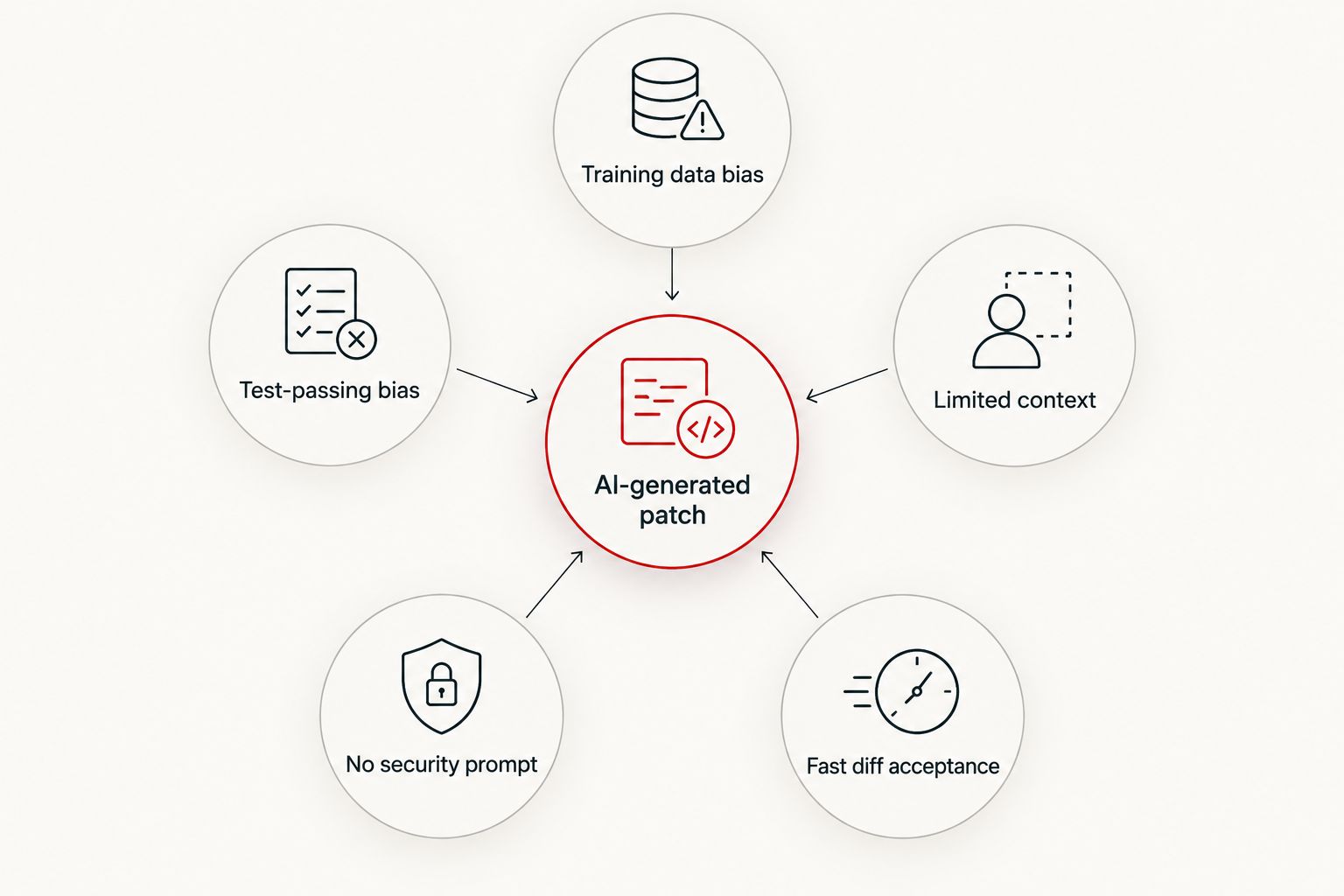
Why AI coding agents introduce these vulnerabilities
- Training data includes insecure code. Public repositories are full of string-concatenated SQL and hardcoded API keys, and an agent trained on that corpus reproduces the pattern unless told otherwise.
- Agents optimize for passing tests, not for safety. The objective is 'make the red X go green,' and a vulnerability that doesn't break a test is invisible to that objective.
- Limited context window. An agent patching one file doesn't always see the auth middleware three files away, so it assumes the caller is already authorized.
- Prompts rarely specify security constraints. 'Add a search endpoint' doesn't say 'parameterize the query' — the agent fills the gap with whatever pattern is statistically common.
- Diffs get accepted faster than they get read. A ten-line patch that passes CI gets merged in minutes; the review that would catch a missing sanitization step gets skipped under deadline pressure.
- No separation between test-environment assumptions and production assumptions. Code that works against a seeded test database with no adversarial input behaves differently once it's live.
Where AdaptOrch fits — and where it doesn't
AdaptOrch is a code-verification tool, not a security scanner. It runs an AI-generated patch in an isolated sandbox before and after the change and produces a receipt that separates a real code failure from an environment or runner failure — the false positives that make teams stop trusting CI red.
That receipt confirms the patch does what it claims under the harness you specified. It does not confirm the patch is free of CWE-89 or CWE-798 — that's a job for a SAST tool or a human review, and AdaptOrch doesn't claim otherwise. Pair sandbox verification with a security-focused review pass; using one in place of the other leaves a gap.
Teams building that combined workflow can see the mechanics in how AdaptOrch flags environment failures automatically when Claude Code tests fail for reasons that have nothing to do with the code.
See what your AI patches actually broke
AdaptOrch runs the diff before and after and separates real failures from noise.
Should you auto-merge AI-generated code?
No, not without a verification step in between — auto-merging AI-generated code skips the moment where a human or a scanner would catch a hardcoded secret or an unscoped query. Teams that auto-merge on green CI in 2026 are betting that 'tests passed' equals 'safe to ship,' and the vulnerability classes above show that bet doesn't hold for auth, payments, or data-access code.
Do AI code review tools catch security vulnerabilities?
Some do, and coverage varies by tool and by how it weighs a security finding against a false positive. Review tools built specifically for AI-generated code differ in how aggressively they surface CWE-class issues versus style nits, which is why the false-positive rate matters as much as the detection rate when picking one.
What's the difference between a runner failure and a real security bug?
A runner failure means the test infrastructure broke — a flaky network call, a missing environment variable, a stale container — and has nothing to do with the code's logic or safety. A real security bug means the code is exploitable regardless of how the test environment behaves. Conflating the two is how teams either dismiss a real vulnerability as 'flaky CI' or burn hours debugging an environment issue as if it were a code defect.
Are some AI coding agents safer than others?
The agents themselves don't publish comparable security benchmarks, so the honest answer is that the prompt and the review process around any agent — Cursor, Claude Code, Codex, or another — matter more than which agent generated the patch. Constraining the prompt to specify a secure pattern reduces the defect rate more reliably than picking one agent over another.
FAQ
Can AI coding agents introduce security vulnerabilities into production code?
Yes — hardcoded secrets, SQL injection, and missing authorization checks are the most common vulnerability classes AI coding agents introduce in 2026. These flaws pass local tests because tests check behavior, not exploitability, which is why they reach production undetected.
Is Cursor safe to use for production code?
Cursor is safe to use when the generated patch goes through a security review or a scan before merge; it is not safe to auto-merge on a green test suite alone. The risk isn't specific to Cursor — it applies to any AI coding agent generating unreviewed patches.
Does Claude Code introduce more vulnerabilities than writing code by hand?
There's no published, agent-specific vulnerability rate to compare directly, but the mechanism that causes vulnerabilities — optimizing for passing tests rather than for security — applies to Claude Code the same way it applies to any AI coding agent. Review its patches with the same scrutiny you'd apply to Codex or Cursor output.
How much does a bad AI code merge cost a team?
The direct cost of a bad AI code merge is incident response, rollback, and re-deploy time, plus any customer-facing downtime before the issue is caught. The indirect cost — lost trust in the review process — often costs more, because it slows down merges across the whole team, not just on the code that failed.
Should you use a SAST tool alongside AI coding agents?
Yes — a SAST tool catches vulnerability classes like SQL injection and hardcoded secrets that a sandbox verification tool or a passing test suite won't flag. Running both together closes the gap between the patch works and the patch is safe.
What's the most common vulnerability AI coding agents introduce?
Hardcoded secrets (CWE-798) and SQL injection (CWE-89) are the most common vulnerability classes reported across AI-generated code in 2026, largely because both patterns pass local tests without triggering a failure.
Can a code-verification tool replace a security review?
No — a code-verification tool like AdaptOrch confirms whether a patch's test failures are real or caused by the environment, which is a different claim than confirming the patch is secure. Keep a security review or SAST scan as a separate step regardless of what verification layer you run.
One last thing
The riskiest AI-generated patches aren't the ones that fail review — they're the ones that pass every check you have and still carry a flaw none of your checks were built to catch. If your only gate before merge is a green test suite, you have exactly one gate, and it was never designed to catch CWE-89 or CWE-798 in the first place. Add a second gate that's actually built for security, not another layer that re-checks the same thing.