
There's no single number for how accurate AI coding agents are in 2026 — pass rates swing by language, task type, and how you define "correct," and the same model can look great on one benchmark and mediocre on your actual repository. The bigger problem underneath the question: a chunk of what gets logged as an agent failure is actually the sandbox or CI runner breaking, not the generated code, and most teams never separate the two.
- No fixed accuracy number exists for AI coding agents in 2026 — results vary by language, task complexity, and benchmark design.
- A real share of reported failures are environment or runner failures, not the AI-generated code itself.
- Benchmark leaderboards measure narrow, curated tasks; your production repo behaves differently.
- AdaptOrch runs each patch in an isolated sandbox and produces a plain-language receipt separating real code failures from runner failures before merge.
- Treat any single "X% accurate" claim about Cursor, Claude Code, or Codex as marketing shorthand, not a guarantee for your codebase.
Why this matters
Engineering teams keep asking how accurate AI coding agents are because the answer changes what they do next: whether a patch gets auto-merged, spot-checked, or fully re-reviewed. Treating a fuzzy accuracy claim as a green light is how broken patches slip into production in 2026 — not because the agent lied, but because nobody separated a real bug from a flaky test runner before hitting merge. The best AI coding agents ranked by hallucination rate page breaks this down model by model, but the short version applies to every agent: a benchmark score is not a warranty.
How accurate are AI coding agents in 2026?
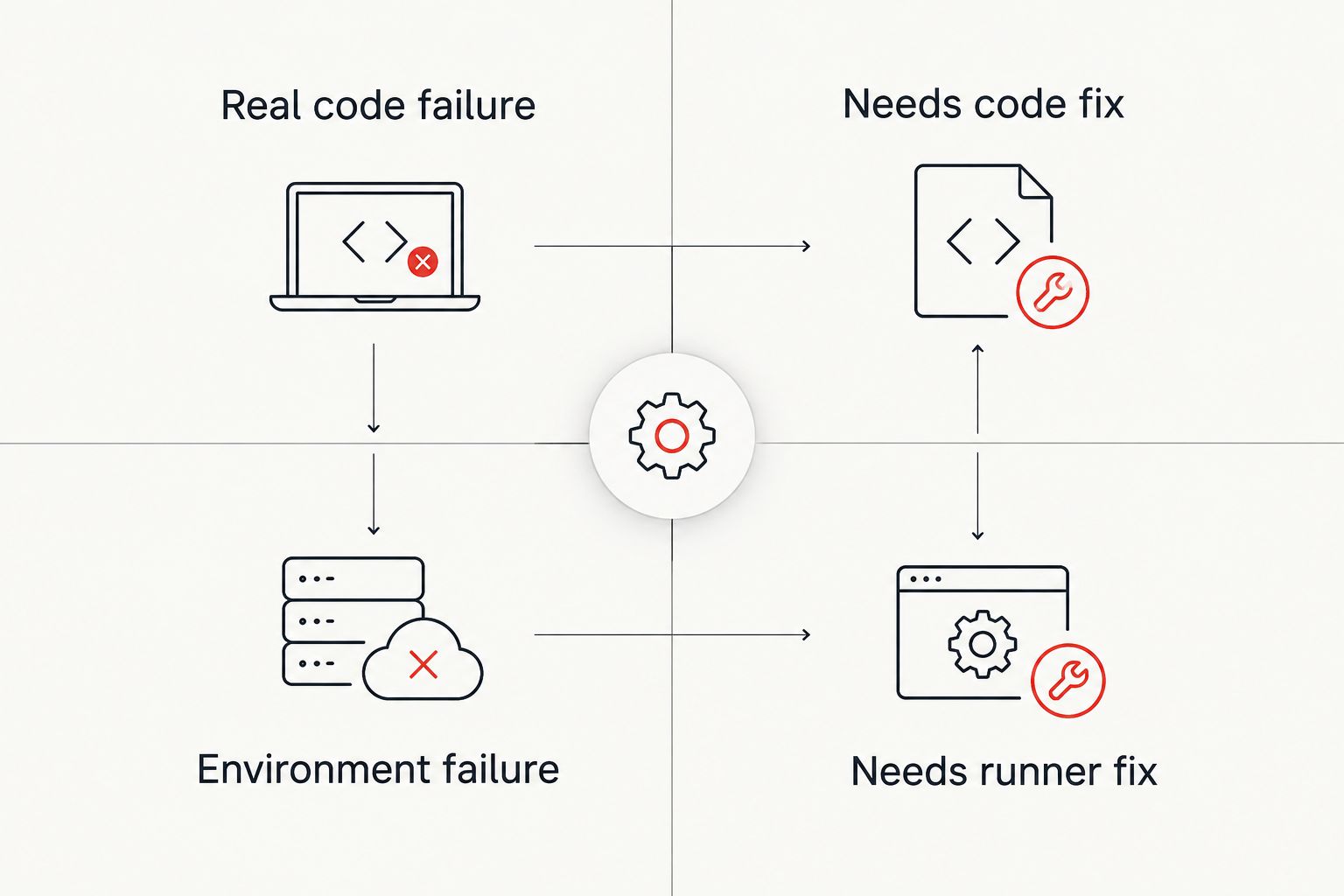
Ask the question a different way and it gets answerable: not "is the agent accurate," but "what kind of failure am I looking at." Every AI-generated patch that doesn't work falls into one of a few buckets, and only one of them is the agent actually being wrong.
| Failure type | What it looks like | What it tells you |
|---|---|---|
| Real code failure | Logic error, wrong edge case, broken function | The agent's code is genuinely wrong |
| Environment/runner failure | Dependency mismatch, stale cache, container timeout | The sandbox or CI setup broke, not the code |
| Flaky test | Test fails intermittently regardless of the patch | Test suite issue, unrelated to the change |
| Hallucinated API/dependency | Agent calls a method or package that doesn't exist | Real failure, but a distinct category worth tracking separately |
Most "accuracy" claims you see marketed in 2026 collapse all four of these into one pass/fail number. That's why two teams running the same agent on the same model version report wildly different success rates — one is counting runner noise as agent failure, the other isn't.
Why accuracy varies so much between teams and benchmarks
- Task complexity — a one-line bug fix and a multi-file refactor are not the same test, even when both get called "a coding task."
- Language and ecosystem — agents trained heavily on Python and JavaScript show different reliability on niche languages, older frameworks, or monorepos with unusual build tooling.
- Definition of "success" — some benchmarks count "tests pass" as success; others require the fix to match a canonical human patch exactly, which is a much stricter bar.
- Benchmark vs. production repo — curated benchmark tasks strip away the messy dependencies, flaky CI, and legacy code that real repos carry, so lab numbers don't transfer cleanly.
- Whether failures get verified at all — a team that never separates real bugs from runner failures will report a lower apparent accuracy than one that does, even with the identical agent and identical code.
- Model version drift — providers ship new model versions every few months in 2026, and each release can shift benchmark rankings without any change to your workflow.
The best sandbox tools for testing AI-generated code comparison covers how isolated test environments reduce the runner-noise problem specifically, which is the single biggest hidden variable in any accuracy claim.
AdaptOrch's approach is deliberately narrow: it runs the patch through an isolated sandbox before and after the change, then produces a readable receipt that states, in plain words, whether a failure is real code breakage or the environment acting up. It does not output a correctness score, and it does not claim the code is right — it tells you which kind of failure you're looking at, so the review that follows is aimed at the actual problem.
Are AI coding agents getting more accurate over time?
Model providers ship new versions every few months in 2026, and each release tends to move benchmark rankings, but there's no fixed accuracy trajectory that applies to every team. What actually improves your real-world results is verifying every patch the same way regardless of which model produced it, so gains from a new model version show up as fewer real failures rather than getting lost in runner noise.
Is Claude Code more accurate than Cursor or Codex?
No agent holds a fixed accuracy edge across every language and task type in 2026 — rankings on public leaderboards shift month to month and benchmark to benchmark. If you're choosing between them, the best AI coding agents roundup compares them by category rather than a single score, which matches how uneven the real performance gap actually is.
Can you trust AI-generated code without review?
No — every AI-generated patch needs some form of verification before merge in 2026, because a passing agent report doesn't tell you whether the pass was real or the runner just happened to cooperate. Auto-merging on agent confidence alone, without separating real failures from environment noise, is how silent regressions reach production; the is it safe to auto-merge AI-generated code guide walks through where that assumption breaks down.
“A passing agent report doesn't tell you whether the pass was real or the runner just happened to cooperate.”
See the verification step before you merge
Run every AI-generated patch through an isolated sandbox and get a plain-language receipt, not a score.
FAQ
How accurate are AI coding agents in 2026?
There's no fixed accuracy number — pass rates vary by language, task complexity, and how failures get classified. A share of reported failures are environment or runner issues, not real code bugs, which is why raw accuracy claims are hard to compare across teams.
What's the most accurate AI coding agent right now?
No single agent holds a fixed lead across every language and task type in 2026 — rankings shift by benchmark and by model version. Compare them by category and language fit rather than one headline score.
Why do AI coding agents fail tests that should pass?
A meaningful portion of test failures are caused by the sandbox, container, or CI runner breaking, not the generated code itself. Separating the two before you debug saves time chasing a bug that doesn't exist.
Is it safe to auto-merge AI-generated code in 2026?
Not without verification — a passing agent report doesn't confirm the code is actually correct versus the runner simply not failing. Every patch needs a check that distinguishes real failures from environment noise before it reaches production.
Do benchmark scores predict how an agent performs on my codebase?
Not reliably — benchmarks run curated tasks in clean environments, while production repos carry legacy code, flaky tests, and unusual build tooling that benchmarks don't capture. Treat benchmark scores as a rough signal, not a guarantee.
How does AdaptOrch measure AI code accuracy?
AdaptOrch doesn't output an accuracy score — it runs the patch in an isolated sandbox before and after the change and produces a readable receipt stating whether a failure is real code breakage or an environment/runner issue.
Are hallucinated APIs counted as accuracy failures?
Yes, but they're a distinct category from logic bugs or environment failures — an agent calling a method or package that doesn't exist is a real failure worth tracking separately from flaky-test or runner noise.
Does a newer model version mean higher accuracy?
Not automatically — new model versions ship every few months in 2026 and often move benchmark rankings, but real-world accuracy on your repo depends more on your test suite and verification process than on the model version alone.
One last thing
The teams that stop arguing about "how accurate is agent X" and start logging real-failure-versus-runner-failure on every patch are the ones who actually improve their numbers in 2026 — the metric that matters isn't the agent's benchmark score, it's your own real-failure rate over time, and you can't track that without separating the two failure types first.