
Yes, AI coding agents still need human code review in 2026 — the real question is what a human reviews versus what a sandbox checks first. Route every agent-generated patch through an automated verification pass before a person reads the diff, because most failures on AI-generated patches are runner or environment noise, not the logic bugs a reviewer is trained to catch.
- AI coding agents need human code review for intent and architecture; a sandbox should catch environment noise first.
- Most CI failures on AI-generated patches are environment or runner problems, not real bugs a human needs to see.
- Auto-merging on 'tests passed' alone lets a flaky runner wave a broken patch straight into production.
- Human reviewers are best used for judgment calls, not for re-running tests an AI agent already claimed passed.
Why this matters
Cursor, Claude Code, and Codex generate patches fast enough that a team can merge a dozen a day without a person reading most of the diff. That speed is the entire selling point of an AI coding agent — and it's also the first thing that gets cut when a team is under deadline pressure.
Skipping review is not the same problem as skipping verification. A human scrolling a diff and approving it, and a sandbox running that code before and after the patch, answer two different questions: one asks "does this look right," the other asks "does this actually run." AdaptOrch, an AI code verification tool, exists because those two questions get conflated on AI-generated code far more often than on code a person wrote by hand.
Do AI coding agents need human code review?
Yes. No AI coding agent shipping in 2026 — not Cursor, not Claude Code, not Codex — verifies intent. They verify whether a patch runs, and even that check is only as good as the runner it ran on. Intent is a human question. Runtime correctness is a question a sandbox can answer before a human spends time on it.
| Traditional human review | AI-agent patch verification | |
|---|---|---|
| Catches | Design flaws, unclear naming, missed logic edge cases | Test failures, broken imports, dependency drift, flaky runner state |
| Misses | Whether a "passing" test actually ran against the right environment | Whether the fix matches the actual business intent |
| Speed | Minutes to hours per pull request | Seconds to minutes per patch |
| Best for | Architecture, security implications, structure | Separating a real code failure from an environment failure before it reaches a human |
The two aren't substitutes. Verification narrows what a human has to look at — it doesn't replace the judgment call at the end of that narrowing.
What breaks when AI-generated code skips review
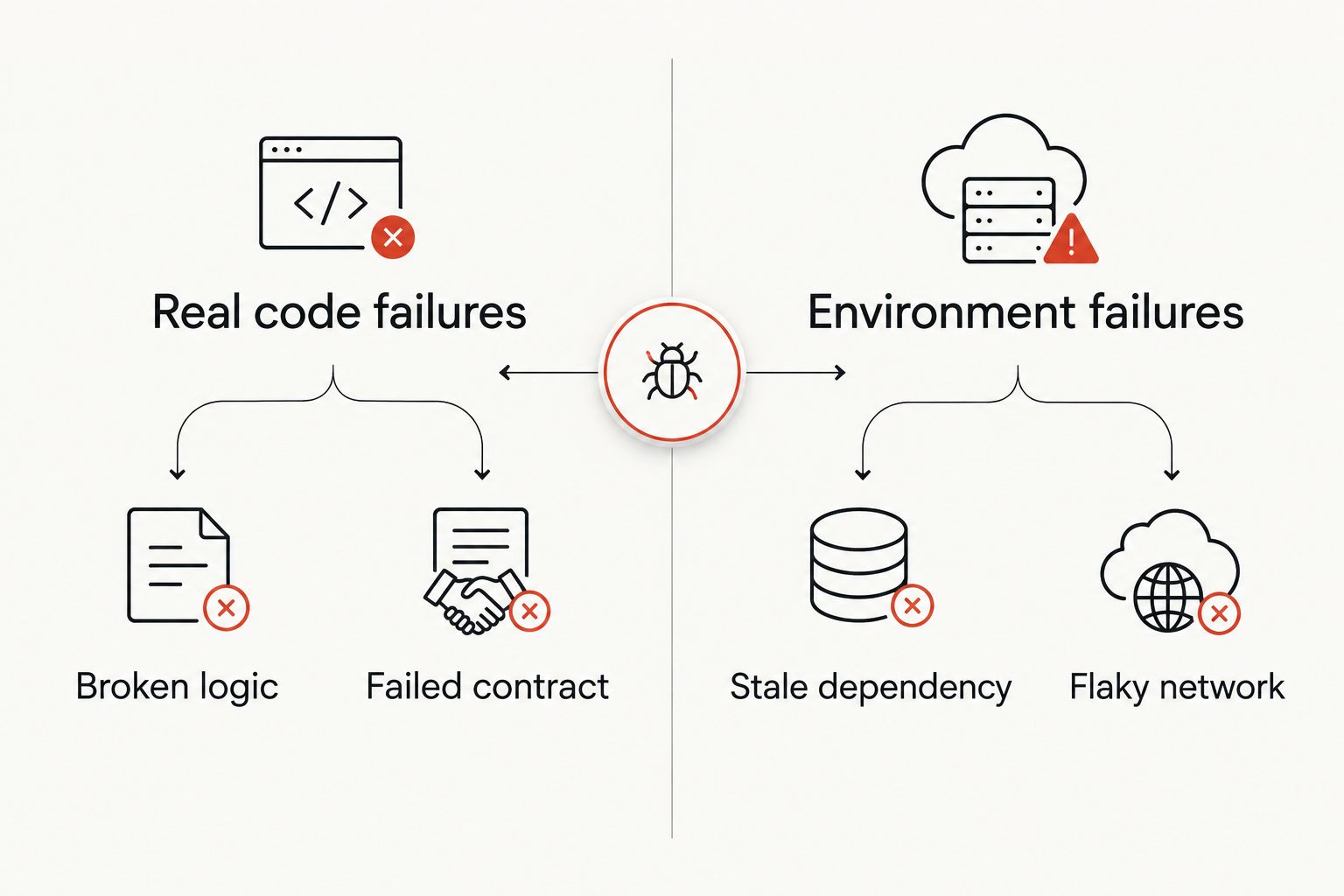
Two categories of failure show up on AI-generated patches, and teams that skip review conflate them constantly:
- Real code failures — the patch changes behavior in a way that breaks a test, a type check, or a downstream contract. This is the failure a reviewer is trained to catch.
- Environment and runner failures — the sandbox has a stale dependency, a flaky network call, or a version mismatch that has nothing to do with the patch itself. Flagging these automatically before a human reads the failure log keeps the review cycle from chasing a ghost.
A team that merges on "tests pass, ship it" without separating those two categories ends up debugging its CI runner instead of its code — or worse, merging a patch that only passed because the runner was broken in a way that happened to hide the bug.
Why review requirements vary by team
How much human review an AI-generated patch needs depends on a handful of factors, not a fixed rule:
- What the code touches. A patch to a billing function or an auth check needs a human set of eyes regardless of what verification says; a patch to an internal script doesn't carry the same weight.
- Regulatory exposure. Healthcare, fintech, and other regulated teams carry audit requirements that a sandbox receipt alone doesn't satisfy.
- Team size. A solo developer reading every line personally has a different bottleneck than an enterprise team merging hundreds of pull requests a week.
- CI maturity. Teams with flaky test suites misread more AI patches as broken than teams with a stable runner — the noise floor is team-specific.
- Which agent generated the patch. Cursor, Claude Code, and Codex show different failure patterns; a team that tracks which agent produces more environment noise routes review time accordingly.
- How much is already auto-merged. Teams already auto-merging low-risk changes need a stronger verification signal before extending that policy to AI-generated code.
Can AI code review tools replace human reviewers?
No — AI code review tools narrow what a human has to check, they don't replace the check itself. A reviewer still owns the decision on intent, architecture, and whether the change does what the business actually asked for; an automated tool owns whether the code runs and whether a reported test failure is real.
Is it safe to auto-merge AI-generated code without any review?
No, not without a verification step in front of the merge — auto-merging on "tests passed" alone means a flaky runner can wave a broken patch straight into production. The safety question around auto-merging AI-generated code usually comes down to whether the team can tell a real test failure from an environment failure before the merge button gets pressed.
How much does a bad AI code merge cost a team?
The cost of a bad AI code merge depends on what broke and how long it sat in production, and it climbs fast once a bad patch reaches a customer-facing path. What a bad AI code merge actually costs a team breaks the categories down — incident time, rollback time, and the review hours spent finding a bug a sandbox run would have flagged before merge.
Where AdaptOrch fits in this loop
AdaptOrch runs an AI-generated patch in an isolated sandbox before and after the change, then produces a plain-language receipt naming whether a failure is a real code problem or a runner problem. It does not claim the patch is correct — correctness stays a human call — it only claims the failure category is accurate.
That's a narrower job than a full AI code review tool. AdaptOrch is best for teams that already have a review process and want to stop spending review hours on environment noise, not for teams looking for a tool that approves pull requests on its own.
“A test that fails because of a broken runner has told you nothing about the code.”
Connect verification to your PRs
Route every AI-generated patch through a sandbox before a human opens the diff.
FAQ
Do AI coding agents need human code review in 2026?
Yes, AI coding agents need human code review in 2026 even with automated verification in place. Verification tells you whether a patch runs; a human still decides whether it does the right thing.
Can AI catch its own coding mistakes?
No, not reliably — an AI coding agent can run its own tests, but it can't judge whether the outcome matches what you actually asked for. A separate verification pass or a human reviewer catches what the agent's own test run misses.
What's the difference between code review and code verification?
Code review is a human judging intent, structure, and risk; code verification is a sandbox run confirming the patch actually works and separating a real failure from a runner problem. Verification happens before review, not instead of it.
Should I trust test results from Claude Code or Cursor without checking them?
No — treat a 'tests passed' message from Claude Code or Cursor as a claim, not a fact, until it runs in an isolated environment. Agents report what their own runner told them, and that runner can be stale or misconfigured.
Is AI code review the same as AI-generated code verification?
No. AI code review evaluates whether a human would approve the change; AI-generated code verification confirms the patch runs correctly in a clean environment before a reviewer even opens the diff.
How do I tell a real test failure from a flaky environment failure?
Run the patch in an isolated sandbox before and after the change and compare results — if the failure shows up both before and after the patch, it's an environment problem, not the patch. A readable receipt naming the failure category removes the guesswork.
Do solo developers need code review for AI-generated code?
Yes, though the review can be lighter — a solo developer using Cursor or Codex still benefits from a verification pass that separates real bugs from runner noise, since there's no second reviewer to catch a false failure.
One last thing
The fastest way to burn review hours in 2026 isn't bad AI-generated code — it's a team debugging its own CI runner while believing it's debugging a patch. Separate the two questions before a human opens the diff, and review time goes toward the decisions a person actually needs to make.