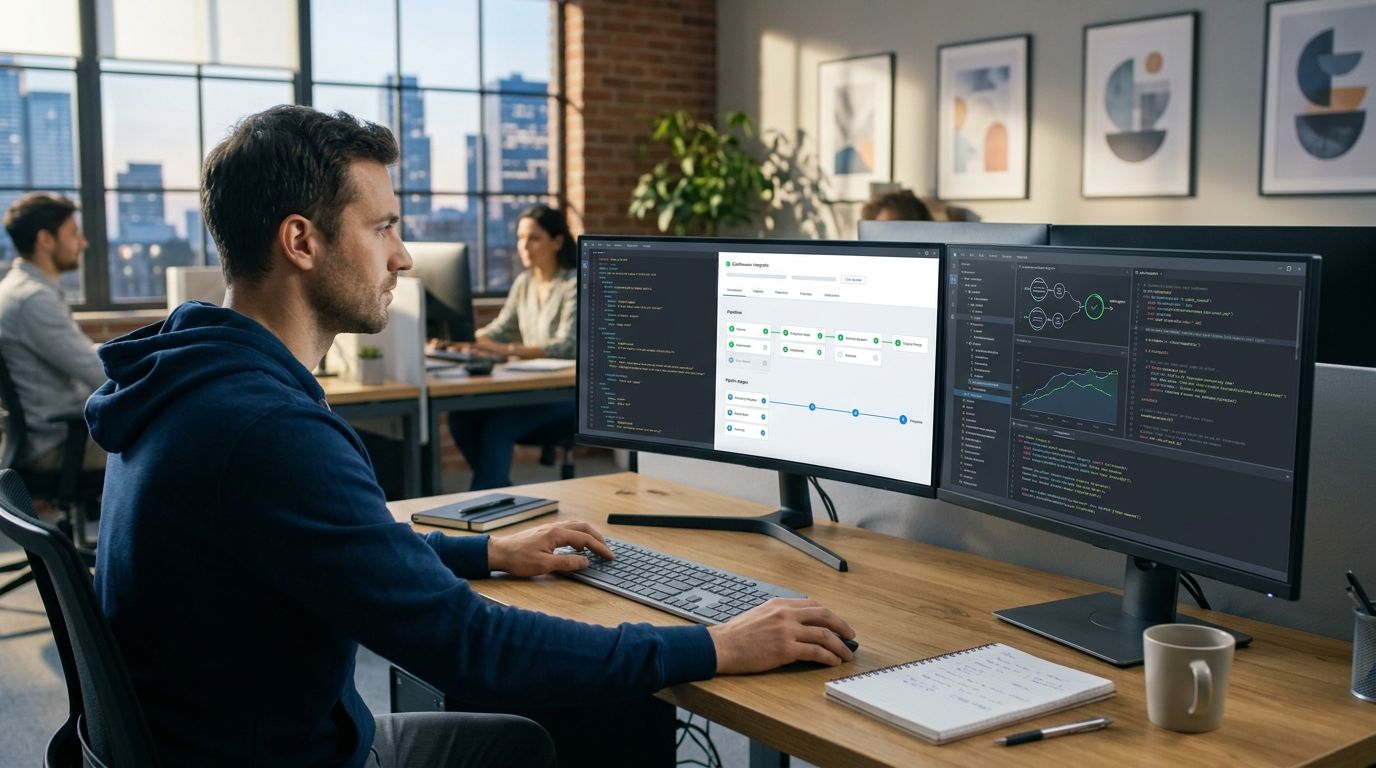
Codex writes the patch. It does not know if the patch is correct — and neither do you, until something actually runs it. Instead of eyeballing a Codex diff and hoping CI catches what you missed, wire every Codex-generated patch through an isolated sandbox before it reaches your main branch, so you get a plain-language receipt instead of a green checkmark you have to trust.
- Codex patches get sandboxed with AdaptOrch before merge, separating real code failures from broken test runners.
- The workflow adds one gate between Codex output and your PR: an isolated run plus a readable receipt.
- AdaptOrch's verdict states correctness_claim: false — it reports what broke, not whether the code is right.
- Works the same whether Codex runs interactively or as a scheduled batch agent in 2026.
Why this matters
Codex is fast at producing patches that look done: tests referenced, imports fixed, diff clean. What it can't tell you is whether a failure after the patch applies is a real regression or a sandbox quirk — a stale dependency, a flaky network call, a runner with a different Python version than your CI box. Teams that skip a dedicated verification step end up doing that triage manually, in code review, which is the most expensive place to do it.
The fix isn't more review. It's a step between Codex's output and your PR queue that runs the patch the same way your CI would, and hands back a verdict in words: real failure, runner failure, or clean. Reference material on tools that verify AI-generated code before merging covers the category if you're comparing options; this guide is the setup for doing it with Codex specifically.
Before you start
- Codex access with repo permissions — write access to the branch Codex commits to, and PR-open permissions on your target repo.
- An AdaptOrch sandbox account (or API key) provisioned against the same repo, with the environment variables your test suite actually needs to run clean.
- The gotcha: if Codex runs its own local test harness before handing you a diff, that harness is almost never the same as your CI harness. Gate this pipeline against your CI command, not Codex's default runner — otherwise you'll verify the wrong thing and get a clean verdict on a patch that fails in production CI anyway.
Set up Codex as the patch source
- In Codex, configure output to land on a consistently named branch pattern — something like
codex/*— so downstream tooling can find it without manual triage. - Confirm the Codex task definition points at the same base branch and repo that AdaptOrch will run its sandbox against. A mismatch here is the single most common setup error in 2026 Codex pipelines.
- Turn off any Codex auto-merge setting for that branch pattern. The patch needs to stop at the sandbox before it goes anywhere near main.
Expected result: every Codex run produces a diff on a predictable branch that a sandbox tool can pick up without hand-editing.
Configure the AdaptOrch sandbox run
- Point the AdaptOrch sandbox at your repo and the Codex output branch you set up above.
- Set the pre-patch baseline — AdaptOrch runs your test suite once against the unmodified base commit, before the Codex patch applies. This is what makes the before/after comparison honest instead of guessed.
- Apply the Codex patch through the same harness your CI uses: same runner image, same environment variables, same test command. Click Run verification.
- Let both runs finish. Don't cancel the baseline run early — it's the only thing that tells you whether a post-patch failure is new.
Expected result: two test runs, before and after, executed in an environment neither Codex nor your laptop has touched.
Read the receipt before you merge
- Open the receipt AdaptOrch generates for the run.
- Read the verdict line first. It states — in words, not a numeric score — whether the delta between the two runs is a real code failure, a runner/environment failure, or a clean pass.
- If it's flagged as a runner failure (flaky test, missing env var, a timeout that also happens on the unpatched baseline), don't send it back to Codex as a bug report. Fix the runner or rerun the sandbox job. Guidance on how to catch this class of problem lives in the guide on flagging environment failures automatically.
- If it's a real failure — the baseline passed and the patch broke it — only then does the patch go back to Codex for another pass, or to a human reviewer.
Expected result: you triage before code review, not during it, and you stop burning a Codex iteration on a problem Codex can't actually fix because the problem was never in the code.
“A patch that fails in the sandbox and fails against the baseline is a real bug. A patch that fails in the sandbox but the baseline also fails the same way is a broken runner, not a broken patch.”
Trigger verification whenever Codex opens a PR
Running the sandbox manually after every Codex session works for solo developers. It breaks down the moment more than one person is merging Codex output into the same repo — someone forgets, and an unverified patch slips into the queue.
Instead, wire the sandbox call to your PR-open event:
- Configure CI to call the AdaptOrch sandbox automatically as soon as a
codex/*branch opens a PR. - Hold the PR out of the merge queue until the receipt attaches — treat "no receipt" the same as "failing check."
- Apply the same verdict logic: a runner failure blocks the queue for infrastructure reasons, a real failure blocks it for code reasons, and reviewers see which one they're looking at before they open the diff.
This turns "verify before deploy" from a step someone has to remember into a gate nobody can route around. Teams running Cursor alongside Codex can set up the equivalent flow using the Cursor to sandbox verification pipeline — the trigger logic is nearly identical, only the source agent changes.
Troubleshooting
Receipt shows a real failure but the diff looks trivial. Check whether Codex touched a shared dependency file or config, not just the function it was asked to change. Small diffs can still break wide surface area.
Sandbox run times out. A timeout on the patched run that doesn't appear on the baseline usually means the patch introduced a loop or a blocking call — that's a real failure, not an infrastructure problem, even though it looks like one.
Codex's own test run passed but the sandbox failed. The two harnesses aren't running the same command. Align the sandbox's test invocation with your actual CI command, not Codex's default local runner, and rerun.
Same patch verifies clean after failing once with no code change. Log it as a runner flake and move on — don't treat a non-reproducible failure as a Codex defect, and don't waste a Codex iteration trying to "fix" code that was never broken.
Verdict says clean but reviewers still find bugs in review. That's expected and by design — AdaptOrch's verdict carries correctness_claim: false. A clean sandbox run means the patch didn't break what your test suite covers. It doesn't mean the code is right. Test suite gaps are still your problem.
Customize your workflow
Once Codex-to-sandbox is running as a PR gate, the same pattern extends to every other agent touching the repo. If your team also runs Claude Code or Cursor, route their output through the same sandbox and the same receipt format, so reviewers read one kind of verdict regardless of which agent wrote the patch instead of learning a new tool's quirks for each one.
For teams comparing agents by how often this gate actually catches something, the breakdown in AI coding agents ranked by hallucination rate in 2026 is worth checking before you decide which agents get the loosest review policy.
Set up sandbox verification for Codex
See how the receipt separates real failures from runner noise.
FAQ
What does codex verified patches before deploy actually mean?
It means every patch Codex generates runs through an isolated sandbox against a before/after baseline before it merges, and the result is a plain-language verdict rather than just a passing test suite. In 2026 this is typically wired as a PR-gate step, not a manual check.
Is Codex accurate enough to skip manual review?
No. Sandbox verification tells you whether a patch broke something measurable, not whether the logic is correct for your product. Human review still catches intent and design issues a test suite doesn't cover.
How does AdaptOrch tell a real failure from an environment failure?
It runs your test suite once on the unmodified base commit and once with the Codex patch applied, using the same harness both times. A failure that only appears after the patch is a real code failure; a failure present in both runs points to the runner or environment.
Can this run in CI instead of locally?
Yes — the standard setup triggers the sandbox call from a PR-open webhook so verification runs automatically on every Codex branch, without anyone remembering to kick it off by hand.
Does AdaptOrch replace code review?
No. Its verdict explicitly carries correctness_claim: false — it reports what broke or didn't, not whether the code is right for your use case. Review still happens after the receipt clears.
What happens when Codex's local tests pass but the sandbox fails?
That almost always means the two are running different harnesses. Align the sandbox's test command with your real CI command rather than Codex's default local runner, then rerun the verification.
Does this workflow work with agents other than Codex?
Yes. The same sandbox-and-receipt pattern applies to Cursor and Claude Code output; only the branch trigger and source agent change, not the verification logic.
What should I do with a patch flagged as a runner failure?
Don't send it back to Codex as a bug report — fix the runner issue (flaky test, missing environment variable, network timeout) or simply rerun the sandbox job, since the code itself may already be fine.
One last thing
The patches that cause the most damage in 2026 aren't the ones that fail loudly in the sandbox — those get caught. It's the ones that pass a thin test suite clean, verify as clean, and still ship a logic error nothing in your harness covers. A clean AdaptOrch receipt narrows what could be wrong; it doesn't close the file. Treat it as evidence, not a verdict on the code's correctness, because that's exactly what the tool itself claims and no more.