
AI code verification cost isn't a subscription line item you can look up on a pricing page — it's mostly the engineering time your team spends deciding whether an AI-generated patch actually broke something or the CI runner just had a bad day. Tooling and compute are the visible costs. Triage time is the one nobody puts in the budget until it shows up as a week of stalled pull requests.
- AI code verification cost splits into three parts: compute, tooling, and engineering triage time — triage time usually wins.
- AdaptOrch's sandbox re-run cost is small next to the hours engineers spend arguing about a flaky test.
- Tool pricing for AI code verification varies by vendor and seat count — check current plans instead of trusting a fixed figure.
- The biggest cost driver in 2026 isn't the tool, it's how often your test suite lies to you.
Why this matters
Cursor, Claude Code, and Codex generate patches faster than any human reviewer can read diffs line by line. That speed didn't remove the cost of checking the work — it moved the cost downstream, into whoever has to figure out why a test failed after merge.
Teams that skip verification pay later, in debugging time and reverted commits. Teams that verify everything by hand pay now, in review hours that don't scale with agent output. AdaptOrch exists in the gap between those two costs: it runs the patch in a sandbox before and after, and hands back a readable receipt instead of a score.
How much does AI code verification cost?
There's no single number here, and any tool that quotes you one without asking about your test suite is guessing. The honest answer is that verification cost has three components, and they don't scale the same way.
| Cost component | What it covers | Where it typically lands |
|---|---|---|
| Compute | Running the sandbox, executing tests before and after the patch | Usually the smallest line, scales with test suite runtime |
| Tooling | Subscription or self-hosted verification setup | Varies by vendor and team size \u2014 check current pricing directly |
| Engineering time | Reading receipts, separating real failures from environment noise | Usually the largest, especially with a noisy CI history |
The hidden cost the headline question skips: engineering time doesn't show up on an invoice, so it's easy to underestimate until someone tracks how many hours a week goes into re-running a "failed" test that turns out to be a runner problem.
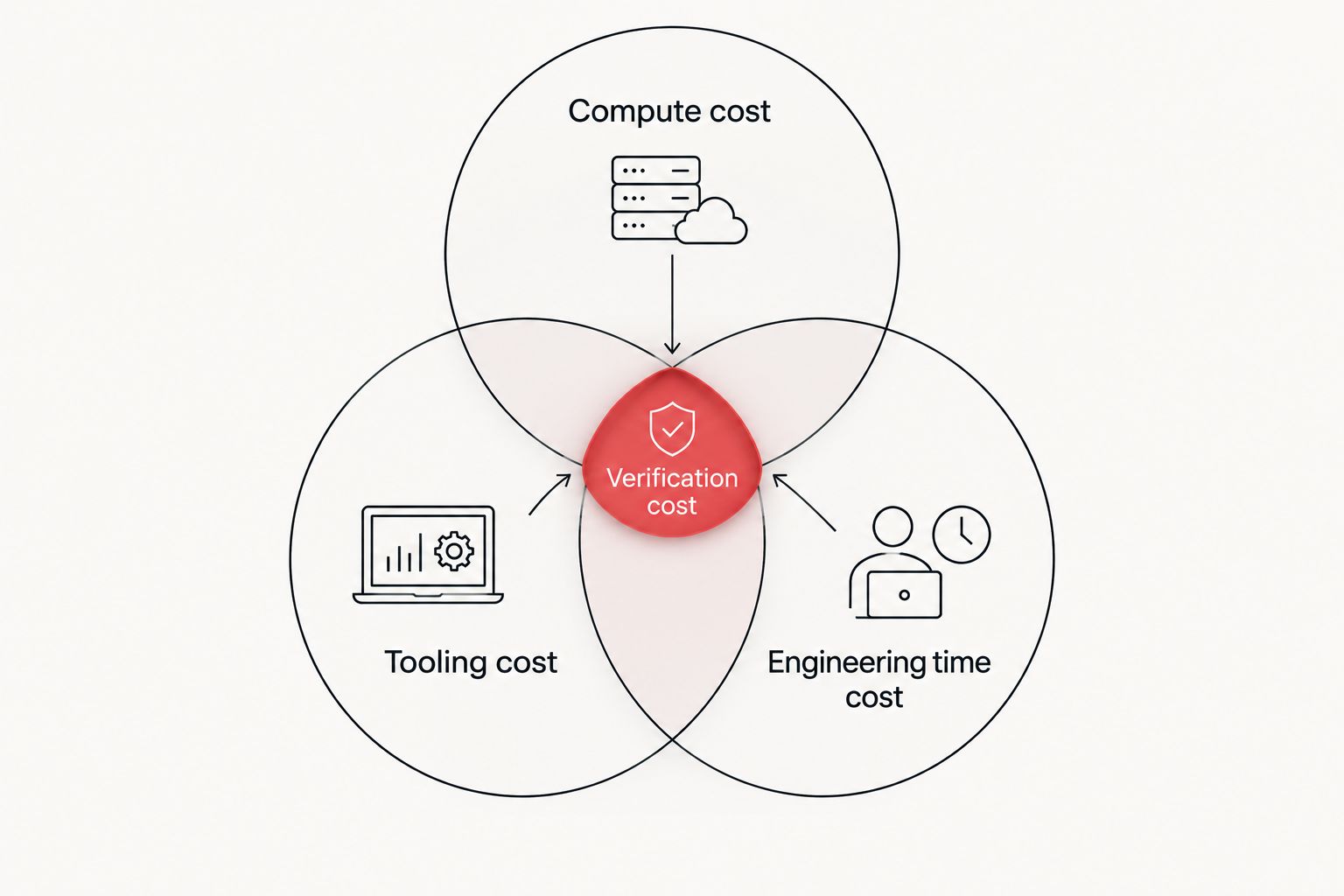
Compute cost: running the sandbox
Every verification pass means executing the codebase's test suite at least twice — once before the patch, once after — inside an isolated environment. For a small repo with a fast test suite, this is close to free. For a monorepo with a 40-minute integration suite, compute adds up fast, but it's still usually cheaper than the alternative: a human re-running tests manually every time a patch looks suspicious.
Tooling cost: subscription vs. building it yourself
You can build a verification pipeline yourself with shell scripts and a CI job that diffs test output before and after a patch. That's not free — it's engineering time spent building and maintaining infrastructure instead of paying a vendor. A dedicated tool like AdaptOrch trades that build cost for a subscription, and the tradeoff usually favors the subscription once your team is applying more than a handful of AI patches a week. Pricing specifics change by plan and seat count, so check the current numbers on the site rather than treat any figure here as fixed.
Engineering time cost: the one that actually hurts
This is where most of the money goes, and it's invisible on a pricing page. A test that fails because of a stale Docker layer or an out-of-disk sandbox looks identical to a real regression until someone spends twenty minutes reading logs to tell the difference. Multiply that by every AI-generated patch your team ships in 2026, and the engineering-time line dwarfs whatever the tool costs.
“A subscription for AI code verification is a rounding error next to the hours engineers burn chasing a test that failed because the runner ran out of disk space.”
Why AI code verification cost varies
- Test suite runtime — a 2-minute suite costs almost nothing to re-run twice; a 45-minute suite multiplies compute cost fast.
- Repo structure — monorepos with shared dependencies produce more cross-patch breakage, which means more triage time per patch.
- CI flakiness rate — a runner that fails for reasons unrelated to code inflates the time spent separating real bugs from noise.
- Patch volume — a solo developer merging a handful of AI patches a week has a different cost profile than a team merging dozens a day.
- Auto-merge policy — teams that gate every AI patch behind human review spend more reviewer time; teams that auto-merge based on test results spend more on getting verification right up front.
- Tool choice — a general CI setup wasn't built to separate a real code failure from an environment failure, so teams using one often pay in debugging time what they saved in subscription cost.
See what a verification receipt looks like
Run a patch through AdaptOrch's sandbox before you estimate the real cost of skipping verification.
Is AI code verification worth the cost?
It's worth the cost when your team ships AI-generated patches often enough that manual triage of every test failure eats real review time. For a solo developer merging one or two patches a week by hand, the math is closer. For a team running Cursor or Claude Code against a shared codebase daily, the cost of a bad AI code merge — reverted commits, broken staging environments, lost trust in CI — usually exceeds what verification tooling costs.
Does AI code verification replace human code review?
No — AI code verification tells you whether a patch broke something and why, not whether the change is the right design decision. AdaptOrch's own stance on this is blunt: it separates real code failures from environment failures and hands you a readable verdict, but it doesn't claim the patch is correct. A human still decides whether the change belongs in the codebase.
What's the hidden cost of skipping verification entirely?
The hidden cost of skipping verification is debugging time spent after merge instead of before it, plus the trust cost of a team that stops believing its own CI. Once engineers assume half of CI's red X's are environment noise, they start ignoring real failures too — and that's a more expensive habit to break than any tool subscription.
FAQ
How much does AI code verification cost in 2026?
There's no single fixed figure — cost splits into compute (running the sandbox), tooling (subscription or self-built), and engineering time (triaging failures), and the last one is usually the largest. Check current tool pricing directly since it varies by vendor and seat count.
Is AI code verification worth paying for?
It's worth paying for once a team merges enough AI-generated patches that manual triage of every test failure starts eating real review time. Solo developers with low patch volume see a smaller return than teams running Cursor or Claude Code daily.
Does AI code verification replace human code review?
No, it doesn't replace human review — it tells you whether a patch broke something and separates real failures from environment noise, but a human still decides whether the change is the right one to ship.
What's the biggest hidden cost of verifying AI-generated code?
The biggest hidden cost is engineering time spent reading test logs to figure out if a failure is real or caused by a flaky runner. That cost doesn't appear on any invoice, which is why teams underestimate it.
Do free CI pipelines already verify AI code well enough?
Free CI pipelines run tests, but most weren't built to distinguish a real code regression from an environment failure, so teams using only CI still absorb the triage cost manually.
How is AI code verification cost different from AI code review cost?
Verification cost covers running the patch and reading its results; review cost covers a human judging whether the change is well-designed. They're separate line items that both apply to AI-generated patches.
Is it safe to auto-merge AI-generated code to save on verification cost?
Auto-merging without verification trades a smaller upfront cost for a larger downstream one, since broken patches that slip through cost debugging time and rollback effort after they hit the main branch.
What factors make AI code verification more expensive for one team than another?
Test suite runtime, repo size, CI flakiness rate, and how many AI patches a team merges per day all push the cost up or down — a fast test suite on a small repo costs far less to verify than a monorepo with a noisy CI history.
One last thing
Before you evaluate any verification tool's pricing, spend a week tracking how many hours your team already loses telling real failures apart from environment noise — that number, not the subscription line, is the actual cost of AI code verification you're trying to reduce in 2026.