
AI code verification doesn't run on a fixed clock: it takes as long as the test suite it reruns, plus the time to spin up an isolated sandbox and diff two runs against each other. In 2026, that puts most patches in the same window as an ordinary CI job, not a separate, slower approval gate — the hidden add-on is a cold dependency cache, which can dwarf everything else in the pipeline.
- How long does AI code verification take? As long as the test suite it reruns plus sandbox setup — not a fixed duration.
- The slowest step is usually a cold dependency install, not the sandbox boot or the diff itself.
- AdaptOrch runs the same suite before and after a patch and returns a verdict in words, not a stopwatch reading.
- Large monorepo suites and low test parallelization are the two most common reasons verification runs long in 2026.
- Verification can run alongside existing CI checks in its own sandbox instead of blocking them.
Why this matters
A verification step that nobody can predict gets skipped under deadline pressure — that's how unverified AI patches end up merged on trust alone. AdaptOrch runs the same test suite before and after a patch, inside an isolated sandbox, and returns a receipt that separates a real code failure from a runner hiccup, instead of a speed score nobody can act on.
Teams shipping with Cursor, Claude Code, or Codex generate patches faster than any human review cycle. The bottleneck moves from "can we write the fix" to "can we trust the fix" — and trust has to run before merge, on a timeline the team can actually plan around.
How long does AI code verification take?
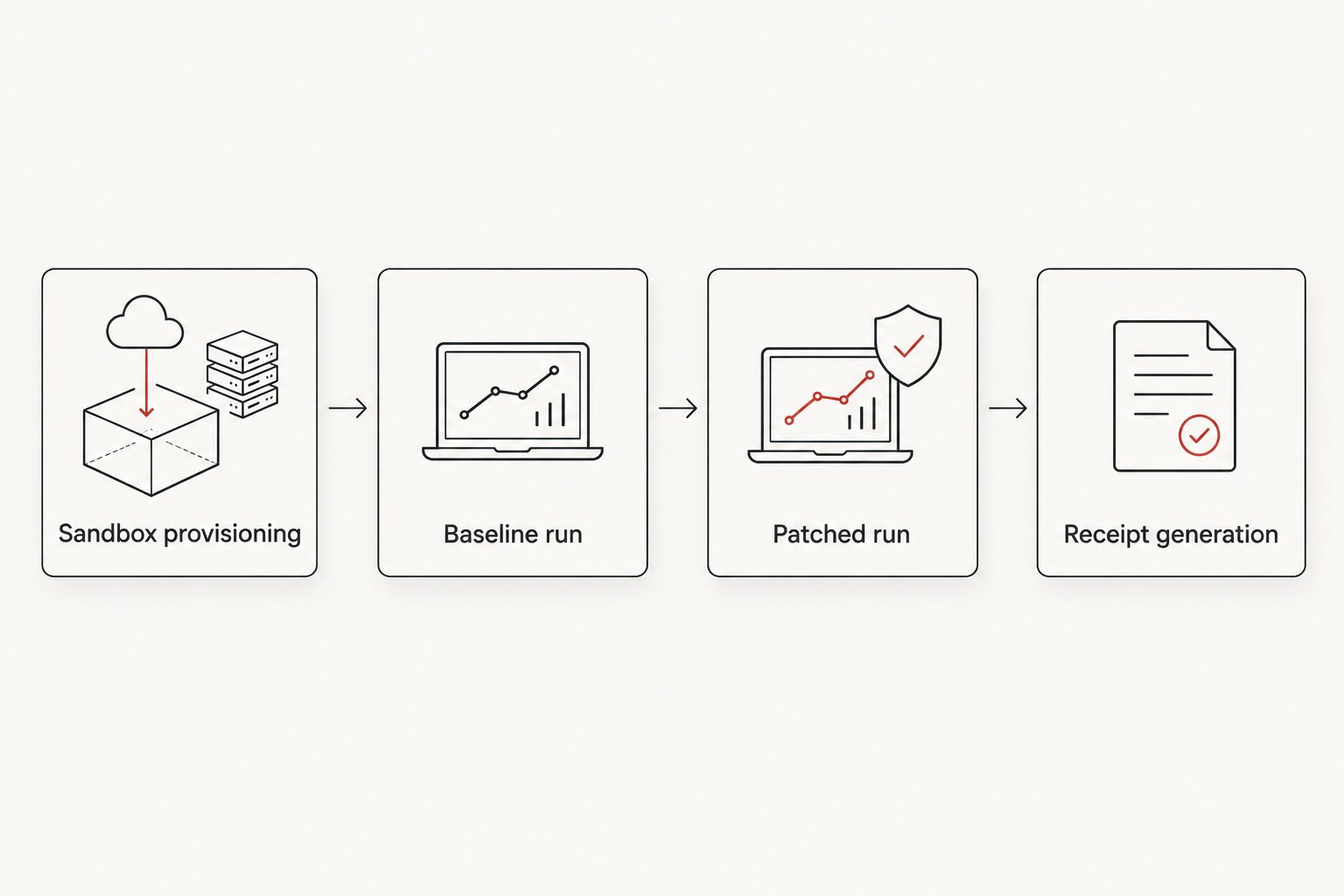
Verification isn't one step — it's four, and each one adds its own time:
- Sandbox provisioning — an isolated environment spins up, matching the intended runner (not a generic container).
- Baseline run — the existing test suite executes unmodified, before the patch touches anything.
- Patched run — the AI-generated diff applies, and the same suite runs again against it.
- Comparison and receipt — the two results get diffed, and real code failures get separated from environment or runner noise.
Steps 2 and 3 dominate the clock in almost every setup, because they're literally your test suite running twice. Step 1 and step 4 are close to fixed overhead; step 2 and 3 scale with however large your suite already is.
Small, isolated patches: fastest to verify
A patch that touches one function and a handful of related tests moves through verification close to instantly, because the baseline and patched runs only need to exercise a narrow slice of the suite. Verdict: expect this to add negligible overhead to a normal PR cycle.
Large refactors and monorepo suites: the long pole
A cross-cutting refactor that touches shared modules forces the baseline and patched runs to exercise most or all of a monorepo's test suite, and that suite is the actual constraint — verification can't be faster than the tests it depends on. Verdict: budget for this running close to your slowest full CI job, because that's effectively what it is.
Cold-cache runs: the hidden time add-on
When the sandbox has to install dependencies from scratch instead of pulling a warm cache, that single step can outlast the baseline and patched test runs combined. Verdict: warm caching is the highest-leverage fix if verification feels slow, not a smaller test suite.
Why AI code verification takes longer on some patches
- Test suite size — the more tests exist, the more both the baseline and patched runs have to execute.
- Cold vs. warm dependency cache — a fresh sandbox reinstalling every package adds time that has nothing to do with the code being verified.
- Test parallelization support — a suite that can't split across workers runs serially, doubling the exposure of a slow suite.
- Sandbox image size — a heavier base image takes longer to provision before any test runs at all.
- CI queue contention — verification competing for the same runners as everything else in the pipeline adds wait time, not execution time.
- Blast radius of the patch — a change that touches many files across modules typically triggers more of the suite than a single-function fix.
A patch that touches one function shouldn't wait behind a suite built for a thousand — if verification takes longer than the patch itself, the sandbox is running the wrong slice of the suite, not doing something wrong.
“If verification takes longer than the patch itself, the sandbox is running the wrong slice of the suite.”
For teams running Cursor patches through this cycle daily, checking sandbox tools for testing AI-generated code against your existing CI tools for AI-generated code verification setup is the fastest way to find where the clock is actually going.
Verify patches before they merge
Runs the same suite before and after, inside an isolated sandbox.
Does AI code verification run on every commit or only before merge?
Most setups trigger AI code verification once per pull request, right before merge, rather than on every commit — rerunning a full suite on every push adds queue time without adding signal. Teams with fast, well-parallelized suites sometimes run it earlier, but merge-gate is the common default in 2026.
Is AI code verification slower than a normal CI run?
AI code verification is not inherently slower than CI, because it typically reuses the same test suite and sandbox mechanics your CI already runs, just twice — once as a baseline, once against the patch. The overhead is the second run, not a separate slow process layered on top.
Can AI code verification run in parallel with existing CI checks?
Yes — because verification executes in its own isolated sandbox, it can run alongside existing CI checks instead of blocking them, as long as the sandbox and CI aren't competing for the same shared runners or cache.
FAQ
How long does AI code verification take?
AI code verification takes as long as the test suite it reruns, plus sandbox setup — there's no fixed duration. Small patches add negligible time; large monorepo refactors run close to your slowest existing CI job.
What's the slowest part of AI code verification?
A cold dependency install on a fresh sandbox is usually the slowest single step, not the test runs themselves or the final diff. Warm caching addresses this directly.
Does a bigger test suite always mean slower verification?
A bigger test suite adds time only if the patch actually exercises most of it. A narrow patch against a large suite can still verify fast if the suite supports test isolation.
Can verification run in parallel with CI checks?
Yes, since verification runs inside its own isolated sandbox separate from the main CI pipeline. Contention only appears if both share the same runners or cache.
Is AI code verification a separate approval stage?
No, it typically sits at the same merge gate as existing CI checks rather than adding a new stage. It reuses the existing test suite mechanics, run twice.
Does verification distinguish real failures from environment failures?
Yes, that's the point of the comparison step in a verification receipt. A runner timeout or flaky dependency gets flagged separately from an actual code regression.
Do AI coding agents need human code review after verification?
Verification narrows what a human reviewer needs to look at, but it doesn't replace judgment on intent or design. It answers whether the patch broke tests, not whether it's the right fix.
One last thing
The step most teams blame for slow verification is the sandbox. It's rarely the bottleneck — a cold dependency install usually costs more time than provisioning the environment and running the diff combined. Fix the cache before you touch the test suite.