
AdaptOrch is worth it in 2026 if your team merges AI-generated patches from Cursor, Claude Code, or Codex and can't reliably tell a real code failure from a broken test runner. It's not worth it if you still write most of your code by hand or accept every red CI badge at face value.
- AdaptOrch is worth it for teams merging AI-generated code from Cursor, Claude Code, or Codex on a regular basis in 2026.
- It runs each patch in an isolated sandbox and hands back a written verdict, not a pass/fail score — correctness_claim is explicitly false.
- Skip it if you write most code by hand or merge AI patches rarely enough to spot-check manually.
- Worth-it scales with how much AI-authored code hits your main branch, not with headcount.
Why this matters
Engineers lose time two ways when an AI coding agent's patch fails a check: chasing a bug that was never in the code, or shipping a bug because a flaky runner happened to pass on retry. AdaptOrch runs the patch through an isolated sandbox before and after it's applied, then writes a plain-language verdict stating which failure actually happened. That distinction is the whole product — it doesn't grade the code, it tells you whether the failure is real.
That sounds narrow until you've spent an afternoon debugging a passing patch that was never broken in the first place.
“A verdict in words, not a score, and it never claims the patch is right.”
Is AdaptOrch worth it in 2026?
Yes, for any team where AI-generated code reaches the main branch regularly and CI failures get treated as gospel without a second look. The table below lines up AdaptOrch against the alternatives most teams are actually running today.
| Approach | What it catches | What it misses | Best for | Verdict |
|---|---|---|---|---|
| AdaptOrch | Real code failures separated from environment/runner failures via a sandbox rerun | Whether the patch is the right fix — correctness_claim is false by design | Teams merging AI patches from Cursor, Claude Code, or Codex regularly | Worth it |
| Manual re-run and spot check | Obvious flakes an engineer happens to notice | Doesn't scale past a handful of patches a week | Solo developers with low AI-patch volume | Hold |
| Generic CI test suite alone | Whether tests pass or fail | Why they failed — a real bug and a broken runner look identical | Teams not yet running AI agents at scale | Wait |
| No verification step | Nothing beyond what the agent itself reports | Everything — merges run on faith | Hobby repos and throwaway scripts | Skip |
The pattern across all four rows: the tools that don't separate failure types don't actually answer the question a failed check is asking. A red X tells you something happened, not what.
Why the verdict varies
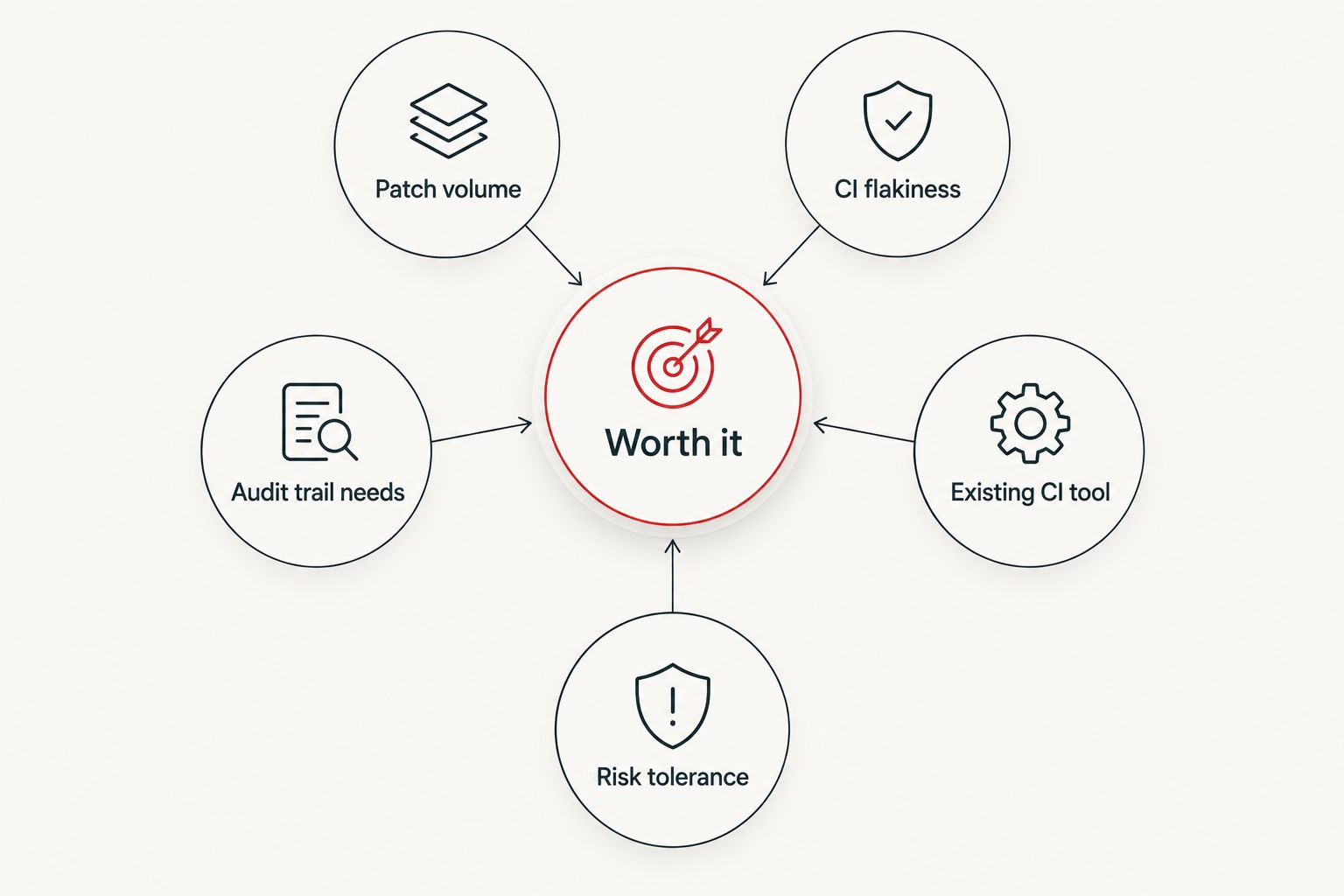
The worth-it math moves on six variables, and headcount isn't one of them.
- Patch volume — the more AI-authored diffs hit your main branch in 2026, the more hours a false "test failed" costs you. See how much a bad AI code merge costs a team for the arithmetic.
- CI flakiness history — if your test runner already breaks on its own, a sandbox rerun matters more than a tool that just re-reads the diff.
- Audit trail needs — regulated teams need a readable record of why a patch was rejected, not a black-box score.
- Existing CI tool — GitHub Actions, GitLab CI, CircleCI, and Jenkins pipelines each need a slightly different hook to trigger the sandbox step.
- Risk tolerance for auto-merge — teams that merge on a green check alone have the most to lose from a fake pass.
- Team size — a solo developer running one agent has fewer moving parts to disentangle than a ten-person team running three.
Related questions worth answering first
Three questions come up right after "worth it" — answer them before wiring anything into CI.
Is it safe to auto-merge AI-generated code?
Auto-merging AI-generated code is safe only when a failed check reliably means the code itself is broken, not when it might mean the runner glitched. Is it safe to auto-merge AI-generated code walks through the conditions that have to hold before a green check means what you think it means.
Do AI coding agents need human code review?
Yes — AI coding agents still need human code review for anything touching production data, security boundaries, or business logic a sandbox test can't fully exercise. Do AI coding agents need human code review breaks down where automated verification stops and a human has to step in.
Is AdaptOrch worth it if you don't use an AI coding agent yet?
No — AdaptOrch verifies patches an AI coding agent already wrote. Without Cursor, Claude Code, Codex, or a similar tool in the loop, there's no AI-generated patch to run through the sandbox in the first place, and a generic test suite covers you fine until that changes.
See the verdict on your own patches
Run a real AI-generated diff through the sandbox and read the receipt.
FAQ
What does AdaptOrch actually check?
AdaptOrch runs an AI-generated patch in an isolated sandbox before and after applying it, then returns a written verdict separating a real code failure from an environment or runner failure. It does not grade whether the fix is the correct one.
Is AdaptOrch worth it for solo developers?
It's worth it for a solo developer who ships code an AI agent wrote, since one person still loses the same hours chasing a fake failure. It matters less for one-off scripts nobody merges.
Does AdaptOrch replace human code review?
No, AdaptOrch isolates why a test failed; a human still has to judge whether the change belongs in the codebase and whether it's the right fix.
Which AI coding agents does AdaptOrch work with?
Cursor, Claude Code, and Codex are the three agents AdaptOrch is built around in 2026.
Does AdaptOrch score code as correct?
No. Its correctness_claim is explicitly false — it reports a verdict in words describing what failed, not a score claiming the patch is right.
What CI tools can trigger AdaptOrch's sandbox step?
GitHub Actions, GitLab CI, CircleCI, and Jenkins pipelines can all run the sandbox rerun as a step in the existing pipeline.
Is AdaptOrch worth it if my CI is already reliable?
It's less urgent but still useful, because a reliable runner doesn't close the gap between "tests passed" and "the patch is actually correct" that a green check alone hides.
One last thing
The receipt AdaptOrch produces includes the line "we do not claim it is right" — that's not a hedge, it's the design. In 2026 the failure mode nobody budgets for isn't a skipped code review, it's a false positive nobody caught because the runner passed on the second try. If a CI badge has ever gone green on a patch that was still broken, that's a runner failure wearing a pass — the exact ambiguity a sandbox rerun exists to remove.