
AI-generated code that runs clean on your laptop can still fail the moment it hits CI, and the code is rarely the reason — the environment is. The patch passes locally and fails in CI because the two places run on different dependency versions, different environment variables, a different filesystem state, or a different base image, and the agent's local test run almost never matches the CI runner it will eventually be judged against. The hidden cost most teams miss: a failing CI job that says "test failed" looks identical whether the code is actually broken or the runner just doesn't have what the code expects, and guessing wrong wastes a re-prompt cycle or, worse, blocks a fix that was already correct.
- AI-generated code passes locally and fails in CI most often from environment drift, not a logic bug, and diagnosing why does ai generated code pass locally but fail in ci starts by separating the two.
- Local runs use a warm cache, your real secrets, and your OS; CI runs cold, sandboxed, on a different base image, so identical code behaves differently.
- AdaptOrch runs the patch before and after in an isolated sandbox and prints a verdict that separates a real code failure from a runner or environment failure.
- Auto-merging on a green CI check in 2026 assumes CI failures mean real bugs, which is exactly the assumption that gets teams burned.
Why this matters
AI coding agents like Cursor, Claude Code, and Codex run tests inside their own local sandbox before a patch ever reaches your repo. That sandbox is convenient, but it is not your CI runner — it often has looser network rules, a cached dependency tree, and environment variables inherited from your terminal session. When the same patch hits GitHub Actions, GitLab CI, CircleCI, or Jenkins, none of that carries over.
The practical failure mode: an engineer sees a red CI check, assumes the AI-generated code is broken, and either re-prompts the agent to "fix the failing test" (which can't fix an environment problem) or manually rewrites code that was never wrong. Both burn time. The fix is diagnosing which side of the failure you're actually looking at before you touch anything.
Why does AI-generated code pass locally but fail in CI
The gap comes down to a handful of concrete differences between where the agent tested the patch and where CI tests it. Here's what typically diverges:
| Dimension | Local (agent sandbox) | CI runner |
|---|---|---|
| Dependencies | Cached install, may predate a lockfile edit | Clean install from the committed lockfile |
| Env vars / secrets | Inherited from your shell or .env | Injected explicitly, often incomplete by design |
| Filesystem state | Leftover files/cache from prior runs | Fresh checkout every job |
| Network access | Often unrestricted | Frequently blocked or throttled |
| OS / base image | Whatever the agent's sandbox uses (often macOS/arm64) | Usually Linux/amd64 container |
| Concurrency | Runs alone, full CPU | Shares resources with other jobs |
Any one of these can produce a CI failure on code that is logically correct. Two or three overlapping at once is common, and that's when the failure looks the most like a "real bug" because the stack trace points at application code instead of the environment.
Why AI-generated code behaves differently between local and CI
- Dependency pinning drift — the agent edits a dependency but doesn't touch the lockfile; local still has the old package cached, CI installs exactly what the lockfile says.
- Missing environment variables — CI intentionally withholds some secrets or config values that your local shell auto-populates, so a feature flag or API key check fails only in CI.
- Filesystem assumptions — code that reads a file, cache, or directory the agent created during its own test run has nothing to read on a clean CI checkout.
- Network restrictions — a test that calls an external service or package registry the agent could reach locally gets blocked or times out on the CI runner.
- Base image mismatches — a native module or system library compiled differently on macOS/arm64 versus the Linux/amd64 CI container behaves or crashes differently.
- Timing and concurrency — race conditions and flaky async tests rarely show up on a runner with a full CPU to itself; they show up when CI shares resources across parallel jobs.
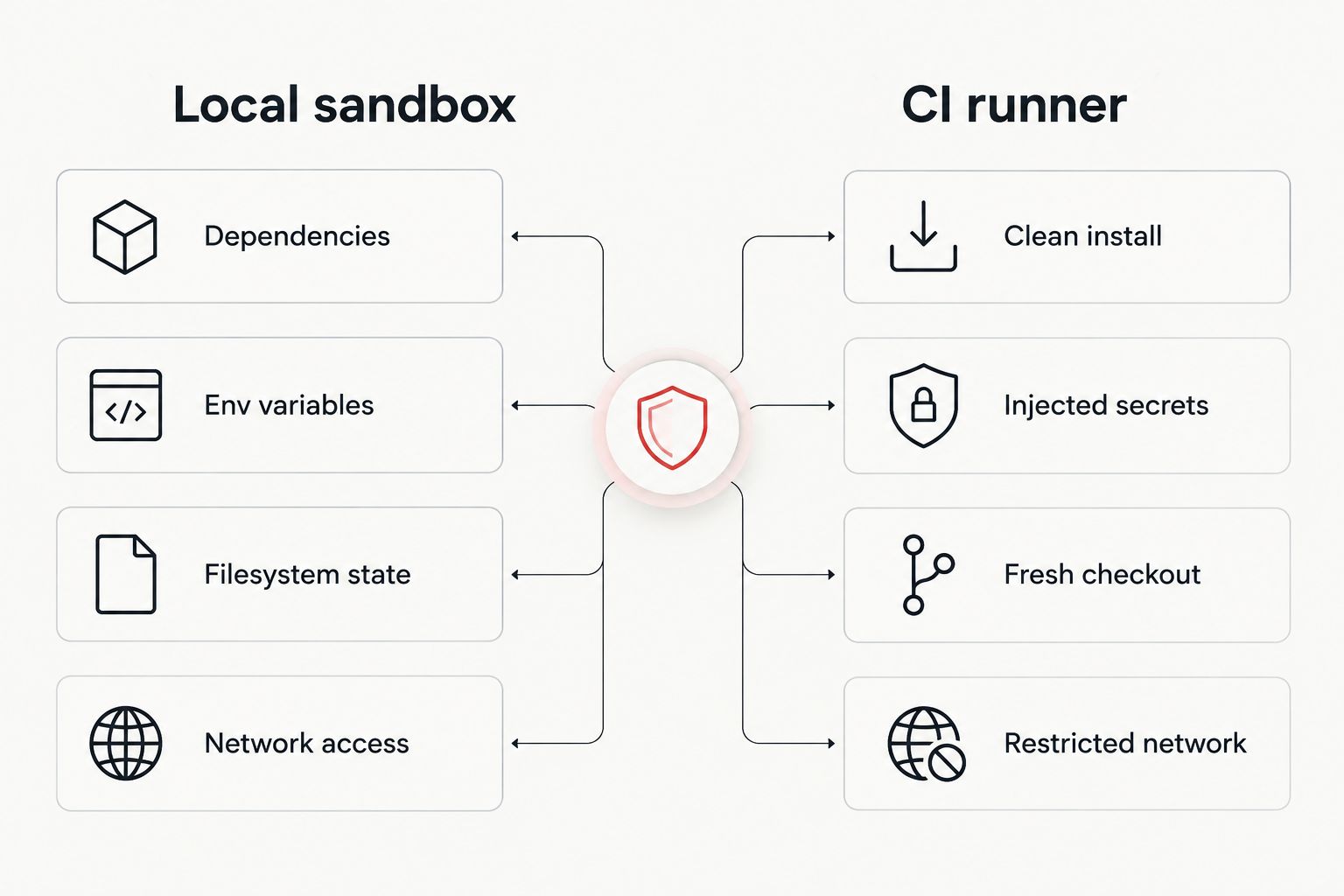
Most teams treat every one of these as "the AI wrote a bug." Separating a real code failure from an environment or runner failure before re-prompting or rewriting is the actual fix, and it's the step most workflows skip in 2026 because it requires re-running the patch in a controlled environment rather than just reading the CI log.
Is a CI failure always a real bug in the code?
No — a CI failure only means the check didn't pass, not that the logic is wrong. A missing environment variable, a network block, or a dependency mismatch between the lockfile and what got installed locally can produce the exact same red X as an actual regression. Read the failure type before assuming the code is at fault.
Can Claude Code or Cursor tell the difference between a flaky test and a real regression?
Not reliably on their own — the agent sees the same failing log you do and has no independent way to confirm whether the environment caused it. Distinguishing a flaky test from a real bug requires re-running the patch in a controlled sandbox and comparing before/after behavior, not just re-reading the stack trace.
Should you auto-merge AI-generated code once CI passes?
A green CI check is a reasonable signal but not proof the patch is correct, and the same logic runs the other way: a red check isn't proof the patch is broken. Treat CI status as one input, not the final verdict, especially on patches an agent generated and tested in a sandbox that doesn't match your pipeline.
“A CI failure and a real code failure produce the identical red X in the log — only running the patch in a controlled sandbox tells you which one you're looking at.”
Verify the patch before CI does
Connect AdaptOrch to your GitHub pull requests and get a before/after receipt on every AI-generated patch.
FAQ
Why does AI-generated code pass locally but fail in CI?
AI-generated code passes locally but fails in CI most often because of environment drift, not a logic error: different dependency versions, missing env vars, a different filesystem state, or a different base image between the agent's sandbox and the CI runner. The code itself may be correct in both places.
Is a CI failure the same thing as a bug in the code?
No. A CI failure means a check didn't pass; it can be caused by the environment, the runner, or the code. Confirm which one before rewriting anything.
How do I tell if a CI failure is flaky or real?
Re-run the exact patch in an isolated sandbox and compare the result before and after the change. A failure that disappears in a clean re-run is environment noise, not a regression.
Can AI coding agents fix their own CI failures?
They can attempt a fix, but if the original failure was environmental, re-prompting the agent to "fix the test" usually produces unnecessary code changes rather than the actual fix, which is an environment or config change.
Does the AI coding agent's local test run match CI?
Rarely. Agents like Cursor, Claude Code, and Codex typically test in their own local sandbox with cached dependencies and inherited env vars, which differs from a clean CI checkout on a different base image.
Is it safe to auto-merge AI-generated code once CI is green?
A green CI check is a useful signal but not a guarantee the patch is correct. Treat it as one input alongside a direct check of what actually changed in the code.
What causes dependency-related CI failures on AI-written patches?
An agent editing a dependency without updating the lockfile is the most common cause. Local keeps the old cached package; CI installs exactly what the lockfile specifies, and the mismatch surfaces as a test failure only in CI.
One last thing
The pattern that costs teams the most time in 2026 isn't the failure itself — it's re-prompting an agent three or four times to "fix" a test that was never broken because the actual problem was a missing environment variable in the CI config. Check the failure type first, fix the code second. A patch verified in an isolated sandbox before it ever hits CI, with a plain-language verdict on whether the failure is real, cuts that guesswork out entirely — that's the exact gap AdaptOrch's receipt is built to close.