No, not by itself. An AI model can't verify its own generated code by re-reading it or re-running it inside the same session that wrote it, because the reasoning gaps that caused a bug are still active when that same model checks its own work. Verification requires execution outside the model: applying the patch in an isolated sandbox, running the test suite before and after, and separating a genuine code failure from an unrelated environment or runner failure. An AI coding agent telling you "tests pass" is a claim, not evidence — and in 2026, that distinction is the whole argument.
- Can AI verify its own generated code on its own? No — the model shares the blind spot that hid the bug in the first place.
- Sandboxed re-execution, not self-report, is the only reliable way to confirm an AI-generated patch works in 2026.
- Environment failures like flaky runners or missing dependencies get mistaken for real code failures without isolated, before-and-after evidence.
- AdaptOrch runs the patch in a sandbox before and after, then produces a plain-language verdict instead of a confidence score.
- Human code review still matters — sandboxed verification narrows what a reviewer checks, it doesn't replace judgment.
Why this matters
AI coding agents like Cursor, Claude Code, and Codex generate patches fast, and by 2026 most engineering teams run at least one of them daily. The problem isn't speed — it's trust. An agent that writes a patch and then reports that the tests pass is grading its own homework with the same blind spots that produced the bug.
AdaptOrch exists because of that exact gap: it runs the generated patch in an isolated sandbox, separate from the model, and produces a readable receipt instead of a confidence score. That's the mechanism question this page answers — not whether an AI tries to verify itself, but whether it can, structurally.
Can AI verify its own generated code?
The honest answer is no. An AI model cannot independently confirm its own patch is correct, because the same reasoning that produced a bug is still running when that model checks its own output. Three approaches exist for closing that gap, and only one of them produces evidence instead of an opinion.
| Method | What it actually checks | Blind spot | Best for |
|---|---|---|---|
| Self-verification (AI re-reads or reruns in the same session) | The model's own confidence in its answer | Shares the same blind spot that caused the bug | Nothing you should merge on |
| Sandboxed re-execution (isolated environment runs the patch before and after) | Whether the suite actually passes, separate from the model's narration | Still needs a human for edge cases the sandbox doesn't cover | Every AI-generated patch before merge |
| Human code review | Design judgment, business logic, security implications | Slow — doesn't scale to every AI-generated commit | High-risk changes and final sign-off |
Sandboxed re-execution is the only one of the three that produces evidence rather than a claim.
How sandboxed verification actually works
A sandbox doesn't just rerun the code — it separates two different questions: did the patch break something, and did the environment break on its own. That distinction is the entire point of running verification outside the model.
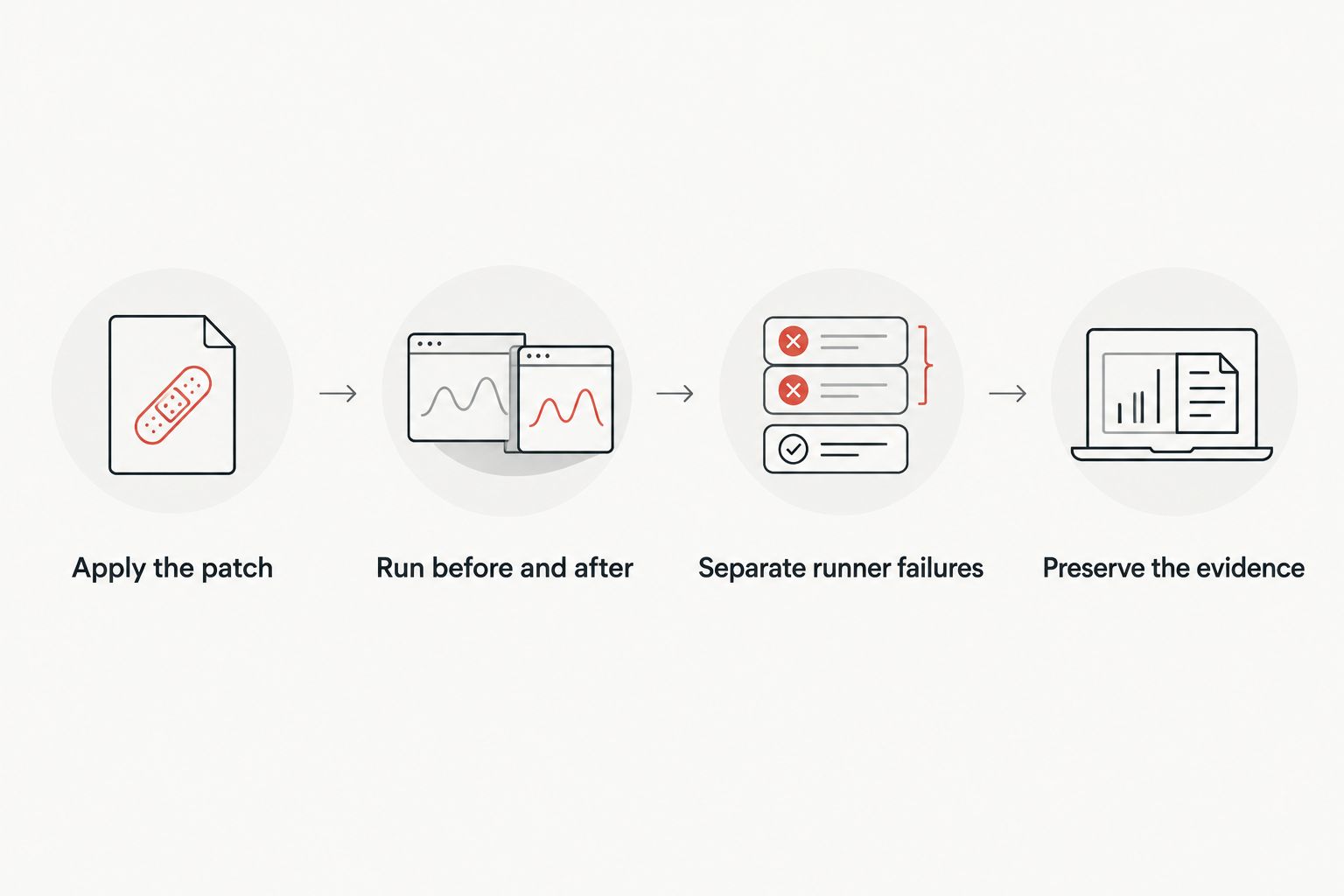
- Apply the patch through the real test harness. Not a snippet, not a diff view — the actual runner, build system, and dependencies the project uses.
- Run the same suite before and after. Without a before state, a failing test after a patch tells you nothing about whether the patch caused it.
- Separate runner failures from real ones. A timeout, a missing package, or a flaky network call is not a code bug — mixing the two into one red X is how AI-generated patches get rejected or merged for the wrong reason.
- Preserve the evidence and its limits. A verdict without the underlying diff and logs is just another unverifiable claim, this time from the tool instead of the model.
AdaptOrch runs this exact four-step sequence: apply, run before and after, separate the failure type, and hand back a receipt in plain language — a note explaining that a login test failed because of a missing environment variable, not because of the patch, reads very differently from a bare red X.
Why AI self-verification fails
- Shared blind spots. The same reasoning that wrote the patch is reviewing the patch — it has no outside vantage point.
- No baseline. Without running the suite before the patch, a pass or fail result afterward has nothing to compare against.
- Confidence bias. Language models are tuned to sound certain, not to flag uncertainty about their own output.
- Confounded failures. A model can't tell an assertion failure apart from a flaky runner or a missing dependency without isolated execution.
- No persistent evidence. A chat transcript stating "tests pass" isn't a log, a diff, or a receipt — it disappears with the session.
- No auto-merge safeguard. Tools that surface only a red or green result, with no separation between failure types, tend to rack up false positives that erode trust in the whole pipeline.
That's the mechanical reason self-verification doesn't hold up:
“A model that says the tests pass has not run the tests — execution is not narration.”
Verify the patch before you merge
Connect AdaptOrch to GitHub pull requests and get a receipt for every AI-generated patch.
Does AI need human code review too?
Yes. Sandboxed verification narrows what a reviewer has to check — it separates real failures from environment noise — but it doesn't remove the need for judgment on business logic, security tradeoffs, or design decisions no test suite checks.
How long does AI code verification take?
It depends on the size of the patch and the suite it runs against, but the sandbox step itself is a machine job, not a manual one — it runs in the background while you keep working, not as a blocking review meeting.
Can AI catch its own hallucinated code?
Rarely, on its own. A hallucinated function call or an invented library import passes right through self-review because the model that hallucinated it still treats it as real — only actual execution in a sandbox surfaces the missing symbol or import error.
FAQ
Can AI verify its own generated code without a sandbox?
No — without an isolated environment, an AI model's self-report that tests pass is a claim, not a result, because the model shares the blind spots that caused any real bug in the first place.
What's the difference between a code failure and an environment failure?
A code failure means the patch broke a test that used to pass; an environment failure means the runner, a dependency, or the network broke, unrelated to the patch. Conflating the two causes both false rejections and false merges.
Do AI coding agents like Cursor and Claude Code verify their own patches?
Not reliably. These agents can run a test suite and report the result, but they don't separate a real failure from a runner failure, and they don't preserve before-and-after evidence for a human to check.
Is it safe to auto-merge AI-generated code?
Only when the patch has run through an isolated sandbox with before-and-after evidence, not just an agent's self-report. Auto-merging on a model's own confidence is how flaky runner failures turn into false rejections or real bugs turn into merges.
How does AdaptOrch verify AI-generated code differently?
AdaptOrch runs the patch in an isolated sandbox before and after applying it, then produces a plain-language receipt that separates a real code failure from an environment or runner failure. It does not claim the patch is correct, only what actually happened when it ran.
Can AI catch its own hallucinated function calls?
Rarely. A hallucinated import or function passes self-review because the model that invented it still treats it as real; only actual execution in a sandbox surfaces the missing symbol.
Does sandboxed verification replace code review?
No. It replaces the guesswork of separating real bugs from flaky infrastructure, but design judgment, security review, and business-logic checks still need a human.
One last thing
AdaptOrch's receipt explicitly carries a field that reads correctness_claim: false. It doesn't tell you the patch is right — only that it ran, what it broke, and what it didn't touch. That's a deliberate limit, not a gap: a tool that claims certainty about AI-generated code in 2026 is making the same kind of unverified claim the AI itself makes when it says the tests pass.